
How Can M&Y Personal Injury Lawyers Help With Car Accident Injuries?
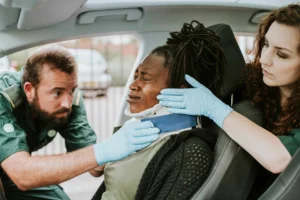 M&Y Personal Injury Lawyers represents people injured in car accidents across California. Several of our attorneys previously represented insurers or corporate defendants before joining the firm. That background shapes how we prepare claims and evaluate evidence.
The car accident attorney managing an accepted case oversees work such as:
- Reviewing the crash evidence, medical records, and available insurance coverage
- Handling communications with insurers and opposing parties throughout the claim
- Documenting the injuries and resulting financial and nonfinancial losses
- Preparing the claim for negotiation or litigation
Contact M&Y Personal Injury Lawyers for a free consultation to discuss your injuries and your options under California law.
What Types of Injuries Can Car Accidents Cause?
A collision can injure bones, muscles, soft tissues, the brain, and other parts of the body. The specific injuries vary from crash to crash.
How Can a Car Accident Cause Chest Bruising?
Chest bruising can occur when the chest contacts a seat belt, steering wheel, dashboard, door panel, or center console during a collision. The specific point of contact depends on the direction of impact and the occupant’s position.
A bruise forms when blunt force damages small blood vessels beneath the skin. This causes discoloration, tenderness, and swelling. Many uncomplicated bruises improve without extensive treatment. Chest pain after a car collision can also result from rib or internal injuries, so persistent or severe pain warrants medical evaluation.
Blunt chest trauma can mask rib fractures, sternal injuries, or internal damage that requires imaging to identify. When follow-up care is delayed because the injury seems small, the missing medical records weaken the connection between the crash and the injury.
What Soft Tissue Injuries Can a Car Accident Cause?
Soft tissue injuries may sound minor, but they can leave a person with lasting physical limitations.
Car accidents can damage muscles, tendons, ligaments, and cartilage. Soft tissue injuries from car accidents can include:
- Muscle strains or tears
- Tendon injuries
- Ligament sprains or tears
- Cartilage damage
Treatment depends on the type and severity of the injury. Treatment for sprains and strains can include rest, pain management, and physical therapy. More severe tears or structural injuries may require surgery followed by rehabilitation.
Soft tissue injuries do not always appear on standard imaging, so medical records become especially important. Symptoms such as pain, stiffness, and reduced range of motion sometimes develop days after the crash. A treatment gap can make it harder to document when symptoms began and whether they remained connected to the collision.
What Broken Bones Can Result From a Car Accident?
 Collision forces can cause fractures when they place more stress on a bone than it can withstand. The location and severity of a fracture depend on where and how the body absorbs impact.
Fractures that can result from a car accident include the following:
- Facial fractures
- Dental fractures
- Broken wrist or arm
- Broken ankle or leg
- Fractured vertebrae
Treatment varies by fracture type and location. Some fractures heal with a cast or splint. Others require surgical realignment or internal fixation with plates, pins, rods, or screws.
Healing time depends on the bone involved, fracture severity, the person’s overall health, and whether complications develop. Broken bones from car accidents range from straightforward fractures to complex injuries requiring extended recovery.
Many fractures are documented through imaging, which can make the initial injury easier to identify than some soft tissue conditions. The claims issue tends to arise around recovery. A fracture that heals with hardware in place, reduced range of motion, or chronic pain raises questions about future medical needs. Surgical records, follow-up imaging, and rehabilitation notes help document how the injury progressed beyond the initial break.
What Are Degloving Injuries After a Car Accident?
A degloving injury occurs when shearing forces separate the skin and underlying soft tissue from deeper tissue layers. These injuries can be open, where the skin is visibly disrupted, or closed, where the skin remains intact but the tissue beneath it separates.
High-energy car accidents are a recognized cause of degloving injuries. The shearing forces involved can damage blood vessels and lymphatic channels in the affected area. Serious complications include tissue death, fluid collection, and infection.
Treatment depends on the location of the injury, the extent of tissue damage, and any associated injuries.
Closed degloving injuries present a documentation challenge because the skin surface may appear intact. Without imaging or surgical findings confirming the internal damage, the full severity is not visible. Photographs, operative reports, and wound-care records help establish what the injury involved and why the treatment was necessary.
How Can a Car Accident Cause a Traumatic Brain Injury?
Rapid acceleration, deceleration, or rotational forces during a car accident can injure the brain. The National Institute of Neurological Disorders and Stroke identifies TBI as a disruption in normal brain function caused by a bump, blow, jolt, or penetrating injury to the head. The result may be temporary or permanent damage from injuries such as the following:
- Concussion
- Diffuse axonal injury (DAI)
- Cerebral contusion
Even a mild brain injury can cause physical and cognitive symptoms. These include headaches, dizziness, confusion, amnesia, and mood or behavioral changes. The CDC notes that some mild TBI symptoms may not appear until hours or days after the injury. A severe brain injury can result in profound disability, coma, or death.
Brain injury claims require careful documentation because the effects are not always visible on standard imaging. A normal CT scan does not rule out every brain injury, particularly a concussion. Neuropsychological testing, specialist evaluations, and records showing how the injury affects daily life and work capacity help establish what the crash actually cost the injured person.
Schedule a Free Consultation With Our Car Accident Attorneys
 When another person’s negligence causes a car accident injury, California law allows the injured person to pursue compensation for losses supported by the evidence.
Contact M&Y Personal Injury Lawyers for a free case evaluation to discuss your injuries and options. Call 866-864-5477. Our phones are answered 24 hours a day, seven days a week. Clients pay no attorney fees unless compensation is recovered.