San Jose Rideshare Accident Lawyer
A crash involving an Uber or Lyft raises a question that ordinary car accidents do not: which insurance policy applies depends on what the rideshare driver was doing in the app at the exact moment of the collision. A San Jose rideshare accident lawyer helps identify fault, determine the driver’s app status, and connect the injury claim to the correct coverage.
That coverage question matters because California ties different insurance requirements to different stages of a rideshare trip. A driver waiting for a request, a driver traveling to pick up a passenger, and a driver carrying a passenger all trigger different minimum coverage levels.
Getting this wrong at the beginning of a claim means pursuing the wrong insurer or accepting the wrong policy limits. We handle rideshare accident claims across San Jose for passengers, other drivers, pedestrians, and bicyclists hurt in crashes involving Uber, Lyft, and other app-based transportation.
If you were injured and are unsure whose insurance applies, call 408-521-1701 for a free consultation.
Table of Contents
Who Has a Claim After a Rideshare Accident in San Jose?
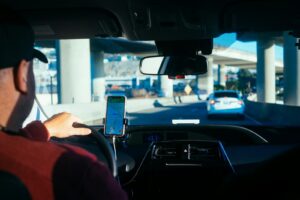
An injured passenger is often a straightforward starting point because the passenger ordinarily is not controlling either vehicle. The coverage and liability questions still matter, though, because the passenger needs to identify whether the rideshare driver, another motorist, or both bear responsibility for the collision.
What About People Outside the Rideshare Vehicle?
When the rideshare driver’s negligence caused the collision, a driver or passenger in another car may pursue a claim against the rideshare driver and any applicable TNC insurance. Whether TNC coverage applies depends on the rideshare driver’s app status at the time.
Pedestrians and bicyclists who are hit by a rideshare vehicle face the same coverage question. The injured person does not have to be a rideshare customer to access TNC insurance when the driver was actively engaged with the platform.
A rideshare driver or passenger who is injured because another motorist caused the collision may have a claim against that driver’s insurance. The coverage analysis differs because the rideshare driver’s own TNC-related insurance may not cover injuries caused by someone else’s negligence in the same way.
Which Insurance Applies After an Uber or Lyft Crash?
California law requires transportation network companies like Uber and Lyft to maintain specific insurance coverage for their drivers, but the required coverage changes depending on where the driver stands in the app. Public Utilities Code § 5433, as amended by SB 371, effective January 1, 2026, sets the current requirements.
The distinction between app periods is not a technicality. It determines the minimum insurance available and which insurer handles the claim.
A crash during a passenger trip triggers $1 million in primary TNC coverage. A crash while the driver is logged in but waiting for a ride request triggers much lower minimums. California’s current TNC insurance requirements break down by what the driver was doing when the crash occurred:
|
Driver’s App Status |
What the Driver Is Doing |
Current California TNC Insurance Requirement |
|
Logged out |
Not using the app for TNC work |
TNC coverage under § 5433 does not apply; other applicable auto coverage must be evaluated |
|
Logged in, no ride accepted |
Waiting for a request |
At least 50,000/100,000 bodily injury and $30,000 property damage, plus at least $200,000 excess |
|
Ride accepted |
Traveling to pick up the passenger |
$1 million primary TNC coverage |
|
Passenger in vehicle |
Transporting the passenger |
$1 million primary TNC coverage |
Each period creates a different starting point for the insurance investigation.
What Changed About Passenger UM/UIM Coverage in 2026?
SB 371 also changed the uninsured and underinsured motorist coverage available to rideshare passengers. Before 2026, California required $1 million in passenger UM/UIM coverage.
The amended statute now requires TNC-provided passenger UM/UIM coverage of $60,000 per person and $300,000 per incident. The Governor’s announcement specifically described replacing the former $1 million requirement with these new limits.
That reduction matters when a rideshare passenger is hit by an uninsured or underinsured driver because the available TNC coverage for that scenario is now significantly lower than it was previously.
How Do You Find Out Whether the Rideshare Driver Was Logged In?
App status is not something the injured person has to guess. California law specifically addresses this issue.
Public Utilities Code § 5435 requires TNCs or their insurers to cooperate with insurers involved in a claims coverage investigation, including exchanging the precise times the driver logged on and off the platform, along with the accident date and time. That cooperation requirement provides a mechanism for obtaining app-status information during the coverage investigation.
The investigation draws on several sources to establish what the driver was doing at the moment of the crash:
- App and trip records showing ride requests, acceptance times, pickup, and drop-off
- Electronic timestamps from the rideshare platform
- The police crash report documenting driver statements and vehicle positioning
- Witness or passenger accounts of whether a ride was in progress
- Vehicle evidence, including dashcam footage or navigation data
Matching these records against the statutory coverage periods identifies which TNC insurance period applies to the claim. That determination is one of the first steps in building the case. Call 408-521-1701 to discuss which coverage period may apply to your rideshare accident.
Who Is Responsible When More Than One Driver Caused the Crash?

California separately provides under Civil Code § 1431.2 that each defendant is responsible only for that defendant’s proportional share of noneconomic damages. The practical result is that the passenger’s claim may involve the rideshare driver’s TNC coverage, the other driver’s personal auto insurance, or both.
What if the Rideshare Driver and Another Driver Give Conflicting Accounts?
Conflicting accounts between drivers are common after any collision and are especially frustrating for a passenger who may not have seen the approach of the other vehicle. Physical evidence, traffic camera footage, electronic data from the rideshare app, and independent witness statements help reconstruct what happened when the drivers disagree.
The San Jose Police Department provides a process for obtaining vehicle accident reports, which document the responding officer’s investigation. That report is one piece of the evidence, but it does not determine civil liability by itself.
What Losses Does a San Jose Rideshare Accident Claim Address?
California Civil Code §3333 sets the general measure of damages in a personal injury claim. In plain terms, the injured person may recover for the harm the wrongful conduct actually caused.
In a rideshare accident claim, those losses reflect what the crash changed about the injured person’s health, income, and daily life. The economic side includes medical treatment, follow-up care, rehabilitation, lost income during recovery, and reduced earning capacity when the injury affects long-term ability to work.
A rideshare passenger, unlike a driver, generally has no vehicle damage claim, but the bodily injury and financial losses may be substantial. Non-economic losses address pain, physical limitations, and the effect on ordinary activities. The damages analysis applies regardless of whether the injured person was a passenger, another driver, a pedestrian, or a bicyclist.
Why Choose M&Y Personal Injury Lawyers?
Rideshare accident claims add an insurance layer that ordinary car accident claims do not. Our attorneys identify the driver’s app status, determine which TNC and personal auto policies apply, and build the injury claim against the correct coverage sources.
We handle Uber and Lyft accident claims across San Jose and California. Our San Jose personal injury practice addresses the underlying negligence and insurance issues in motor vehicle collisions, including crashes involving rideshare vehicles.
We take rideshare accident claims on a contingency-fee basis, so there is no fee unless we win. Consultations are free and available 24/7. Call 408-521-1701.
When Is a Lawyer Particularly Useful After a Rideshare Crash?
A rideshare accident creates an information gap between the injured person and the companies involved. The passenger or other injured party knows what happened to them but does not personally possess the rideshare platform’s trip records, app-status data, or details about every potentially applicable insurance policy.
Uber and Lyft control the platform data. The TNC insurer and the driver’s personal auto insurer each handle their own coverage determinations. When the injured person is navigating that process alone, they are responding to coverage questions without access to the information that answers them.
Our work on a rideshare injury claim addresses each layer of that investigation:
- Identifying the driver’s app status at the time of the collision
- Determining all potentially applicable TNC and personal auto insurance policies
- Obtaining and reviewing available trip and app records through the statutory cooperation process
- Reconstructing fault when drivers give conflicting accounts
- Documenting medical treatment and financial losses
We coordinate with the insurers involved and build the claim around the coverage that actually applies. Our rideshare practice also includes Los Angeles rideshare accident claims involving Uber, Lyft, and other app-based transportation injuries.
What Practical Steps Apply to Rideshare Accident Claims in San Jose?

San José Mineta International Airport maintains designated app-based rideshare pickup areas and identifies Uber, Lyft, Waymo, Wingz, and Tesla among the providers serving the airport. Crashes involving airport pickups or drop-offs may involve airport property records or surveillance in addition to the standard rideshare and police documentation.
What Filing Deadlines Apply to a Rideshare Accident Claim in California?
California’s general personal-injury statute of limitations under Code of Civil Procedure §335.1 provides two years from the date of injury. Claims involving a public entity may require earlier action under Government Code §911.2, and case-specific facts may affect the applicable deadline.
Civil lawsuits in Santa Clara County are filed in the Superior Court’s Civil Division, which handles claims seeking damages for personal injury.
FAQs About San Jose Rideshare Accident Claims
Does It Matter Whether I Booked the Uber or Lyft Ride Myself?
The booking arrangement does not generally determine whether the injured passenger has a claim. A person injured during a ride booked by a friend, family member, or employer still has a bodily injury claim based on the facts of the crash and the applicable insurance.
What if the Rideshare Driver Was an Independent Contractor Rather Than an Employee?
The TNC insurance requirements under § 5433 apply regardless of the driver’s employment classification. California’s mandatory TNC coverage attaches based on the driver’s app status, not on whether the driver is classified as an employee or independent contractor.
Can I Pursue a Claim Against Both Drivers if They Share Fault?
When two drivers share responsibility for a crash that injures a passenger, the passenger may pursue claims against each driver and each applicable insurance source. The allocation of fault between the drivers does not reduce the passenger’s total compensable losses.
What if the Rideshare Company's App Showed a Different Driver Than the One Who Picked Me Up?
Account-sharing or unauthorized driver situations create additional insurance and liability questions. TNC coverage may not apply the same way when the person driving is not the driver authorized on the platform. The investigation examines who was actually driving and what coverage, if any, applies.
What Happens if I Accept a Settlement From One Insurer Before Resolving the Full Claim?
Accepting a settlement from one insurer before the full scope of losses is documented may limit the ability to recover additional compensation later. When multiple policies are involved, the timing and terms of any settlement need to account for the remaining claims and coverage sources.
Let Us Sort Out Which Insurance Applies

M&Y Personal Injury Lawyers offers free, no-obligation consultations for San Jose rideshare accident claims. Call 408-521-1701 or contact us online. We handle these cases on a contingency-fee basis, so there is no fee unless we win.
M&Y Personal Injury Lawyers — San Jose
Address
84 W. Santa Clara St., Suite 723, San Jose, CA 95113
Hours
Open 24/7 for new client calls
PRACTICE AREAS
SEARCH OUR SITE
OUR OFFICES
Los Angeles - Main Office
6300 Wilshire Blvd. Suite 807
Los Angeles, CA 90048
Los Angeles Law Office Map
6300 Wilshire Blvd. Suite 807
Los Angeles, CA 90048
Los Angeles Law Office Map
350 S Figueroa St. Suite 276
Los Angeles, CA 90071
Downtown Los Angeles Law Office Map
Call: (877) 751-8953
402 W. Broadway #400
San Diego, CA 92101
Call: (619) 404-2797
2400 E Katella #800
Anaheim, CA 92806
Call: (714) 386-7623
8050 N. Palm Ave. #300
Fresno, CA 93711
Call: (559) 853-4863
6360 Van Nuys Blvd. #219
Van Nuys, CA 91401
Call: (213) 296-1243
11801 Pierce Street #200
Riverside, CA 92505
Call: (951) 234-5468
99 S Almaden Blvd #600
San Jose, CA 95113
Call: (408) 617-8928
111 West Ocean Blvd. #400
Long Beach, CA 90802
Call: (562) 354-8219
473 E. Carnegie Drive #200
San Bernardino, CA 92408
Call: (818) 650-3861