
What Rights Do Pedestrians Have at Crosswalks in California?
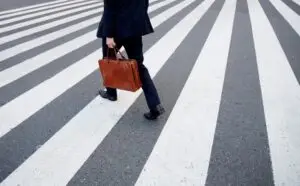 California Vehicle Code § 21950 requires drivers to yield to pedestrians crossing within a marked crosswalk or an unmarked crosswalk at an intersection.
The statute also imposes duties on the pedestrian. A pedestrian may not suddenly leave a curb or other place of safety and walk into the path of a vehicle so close that it creates an immediate hazard. That duty does not erase the driver’s separate obligation. Drivers approaching a pedestrian in a crosswalk must exercise due care and reduce speed or take other action necessary to protect the pedestrian.
California pedestrian right-of-way laws distinguish between crossings inside a marked or qualifying unmarked crosswalk and crossings elsewhere in the roadway. The distinction changes both parties’ legal duties.
How Do Turning Drivers Create Pedestrian Crosswalk Conflicts?
 A pedestrian using a crosswalk with a WALK signal may still face a vehicle turning through the same space. These conflicts involve specific questions about signal phase, driver lookout, pedestrian position, and timing.
Pedestrian fault disputes change depending on where the person crossed and what controlled the crossing. The evidence needs to answer the legal question created by that specific location.
|
Crossing situation |
Legal question |
Evidence that matters |
|
Marked crosswalk |
Was the pedestrian already crossing, and how did the driver approach? |
Crosswalk markings, signals, video, witnesses |
|
Unmarked intersection crossing |
Did the location qualify as an unmarked crosswalk? |
Sidewalk alignment, intersection geometry, signs, photographs |
|
Crossing outside a crosswalk |
Was a vehicle close enough to create an immediate hazard? |
Distance, speed evidence, visibility, video, witness accounts |
|
Signalized crossing |
What signal was displayed when the pedestrian entered? |
Signal timing, video, witness accounts, collision report |
|
Turning-vehicle collision |
Did the driver yield and maintain a proper lookout? |
Vehicle movement, signals, impact location, video |
What Happens When a Driver Turns Right Through a Crosswalk?
A right turn places a vehicle and pedestrian on intersecting paths even when both enter the intersection during the same signal cycle. The DMV instructs drivers turning right on red to stop and yield to pedestrians before completing the turn.
The investigation examines the pedestrian signal phase, whether the pedestrian was already crossing, the driver’s stopping and turning sequence, and the crosswalk location relative to the turn path.
What Happens When a Driver Turns Left Across a Pedestrian’s Path?
A left-turning driver crosses through a crosswalk while managing oncoming traffic, the signal, and the turn itself. The pedestrian may be crossing from the opposite side and enter the driver’s path after the turn begins.
Signal phase, the pedestrian’s location and direction, driver sightline, turn path, vehicle movement, and video or witness evidence help reconstruct the timing. Driver conduct involving turns, signals, and lookout also appears in ordinary vehicle claims. A Sacramento car accident lawyer from our team handles those broader driver-liability issues when the injured road user was inside another vehicle.
Why Does Crossing Design Matter in Sacramento?
 The design of the crossing can affect fault analysis because lane count, traffic speed, sight distance, lighting, medians, transit stops, and intersection controls influence what the driver and pedestrian could see and how they moved through the area.
The City’s Vision Zero work specifically identifies pedestrian crashes outside intersections or crosswalks and crashes near transit stops as pedestrian-safety profiles. Sacramento’s Marysville Boulevard Vision Zero project includes high-visibility crosswalks and lane reductions as part of that effort.
Sacramento projects now incorporate daylighting areas near crosswalk approaches to improve driver sightlines toward pedestrians. California’s daylighting law restricts parking near crosswalk approaches, and photographs of parked vehicles, curb markings, and the driver’s approach angle help establish what each person could reasonably see before impact.
Exact crash location determines which crosswalk type, signal phase, and visibility conditions governed the conflict. Photographs and video documenting the street design at the time of the collision are critical to that analysis.
How Do Signal Timing and Crossing Geometry Resolve a Fault Dispute?
A pedestrian claim lives or fails on evidence that answers the crossing-location question. Signal timing, intersection design, and video help establish when the pedestrian entered the roadway and whether the crossing was marked, unmarked, or outside a crosswalk.
Evidence relevant to establishing the pedestrian’s crossing status includes:
- Crosswalk markings, sidewalk alignment, and intersection geometry at the collision location
- Pedestrian and traffic signal timing and phase
- Surveillance, dash-camera, or traffic-camera video when available
- Vehicle impact location on the roadway
- Photographs of the crossing location taken close to the date of the collision
- Witness accounts describing the pedestrian’s position and the driver’s movement
- The collision report from Sacramento Police or CHP
A collision report documents the investigating officer’s observations, party statements, and scene diagrams. It does not conclusively establish civil fault. The complete evidence, including signal timing, crossing design, and video, determines liability.
When the injured person was riding rather than walking, bicycle-specific lane and roadway rules change the analysis. A Sacramento bicycle accident lawyer from our team addresses those cyclist-specific duties.
How Does a Pedestrian Collision Affect the Body Differently Than a Vehicle-Occupant Crash?
A pedestrian struck by a vehicle has no seatbelt, airbag, or vehicle frame absorbing the impact. The collision sequence typically involves initial vehicle contact, secondary impact with the hood or windshield, and a fall to the roadway. That multi-stage sequence produces injury mechanisms at each point of contact.
The impact sequence described in a pedestrian versus vehicle accident guide matters only when medical records connect those mechanisms to the person’s actual injuries. Emergency imaging, surgical notes, rehabilitation records, and specialist follow-up document which injuries the collision caused and how recovery progressed.
Treatment costs, lost income, reduced earning capacity when supported, future medical care when treating physicians support it, pain, physical limitations, and property damage such as a phone, glasses, or mobility devices all become part of the claim when documented and connected to the collision.
A Sacramento hit by car lawyer at our firm reviews the medical trajectory and work impact alongside the liability evidence.
When Can a Pedestrian Share Responsibility for the Collision?
 A pedestrian’s share of fault reduces recovery without automatically eliminating the claim under California’s comparative-fault system. The reduction is proportional to the assigned percentage of responsibility.
Pedestrian conduct that may enter the fault analysis includes entering the roadway when a vehicle was close enough to constitute an immediate hazard, beginning to cross after the DON’T WALK signal was already flashing, or crossing outside the required crosswalk between adjacent signal-controlled intersections.
Visibility conditions, including lighting, obstructed sightlines, and the driver’s approach angle, also become part of the analysis when one side argues the other was not reasonably visible.
Comparative fault makes the crossing evidence especially important. The investigation identifies whether the pedestrian’s conduct contributed to the collision and, if so, how the assigned share of fault affects the recoverable amount.
Which Pedestrian Fault Disputes Need Closer Legal Review?
Pedestrian claims become harder to evaluate when the dispute depends on the exact crossing location or signal phase, and the relevant evidence is controlled by someone other than the injured person. A Sacramento pedestrian injury lawyer becomes especially useful in these situations:
- The driver or adjuster argues the pedestrian was outside a crosswalk
- The intersection had no painted crosswalk and the unmarked-crosswalk question is unresolved
- The pedestrian signal changed during the crossing
- A turning driver claims the pedestrian entered unexpectedly
- Video, signal-timing data, or other third-party evidence needs identification
- Serious injuries create supported future medical or work-loss questions
Several of these disputes depend on third-party records or physical evidence the pedestrian does not control. A pedestrian accident attorney in Sacramento at our firm reviews these issues at no cost. Call 866-864-5477.
How Do We Evaluate a Disputed Pedestrian Crossing?
We identify whether the crossing was marked, unmarked, signal-controlled, or outside a crosswalk. We compare the driver’s account with signal timing, roadway design, video, and other available evidence. When the facts of the crossing and the driver’s movement conflict, the physical and documentary evidence narrows the dispute.
Several of our attorneys previously represented insurers and corporate defendants. That defense-side perspective informs how we evaluate crossing-location disputes, sudden-entry allegations, visibility arguments, medical causation questions, and comparative-fault positions.
One attorney manages each accepted pedestrian case from the first call through resolution. The same attorney keeps the crossing evidence, signal analysis, medical documentation, and insurer positions connected throughout the claim.
A Crosswalk Dispute Is Not Resolved by Looking for Painted Lines

We evaluate the intersection design, signal phase, driver movement, visibility, and pedestrian conduct to determine which California rules apply. That analysis is what separates a well-investigated pedestrian claim from one built on assumptions about who had the right of way.
We take pedestrian cases on contingency, with no attorney fee unless we recover compensation. The first consultation is free with no obligation. Call 866-864-5477 any time, 24 hours a day, seven days a week.