California drivers must yield to pedestrians in most crosswalks, but that protection is not unlimited, and pedestrians carry duties too. Where you crossed, the signals in place, and how each person acted can decide who pays after a collision.
At M&Y Personal Injury Lawyers, we handle pedestrian injury claims across California. Here we explain the state’s pedestrian right-of-way laws so you can make informed decisions about your claim.
Key Takeaways:
- While drivers must yield in most situations, pedestrians have legal duties that can influence liability after an accident.
- California law protects pedestrians using marked and many unmarked crosswalks.
- An injured pedestrian can still recover monetary compensation even if they share fault in the accident, based on each party’s percentage of responsibility.
- Several California Vehicle Code sections govern pedestrian right-of-way and address various traffic situations.
- Acting quickly after a pedestrian crash helps preserve evidence, such as video footage, before it disappears.
Who Counts as a Pedestrian Under California Law?

California’s legal definition of a pedestrian includes more than someone simply walking down the street. California Vehicle Code § 467 defines a pedestrian as any person traveling on foot. The definition also includes individuals using wheelchairs because they are unable to walk, recognizing that mobility devices should receive the same legal protections as walking pedestrians.
Because the statute covers conveyances propelled by human power other than a bicycle, other non-motorized ways of getting around are generally treated the same as walking, such as:
- Skateboards
- Roller skates
- Roller blades
- Non-motorized scooters
Someone riding a skateboard across a marked crosswalk generally receives the same right-of-way protections as someone walking across the street. The same responsibilities also apply, including following pedestrian signals and avoiding unsafe crossings.
The law also makes clear who is not considered a pedestrian. For instance, people operating bicycles, electric bicycles, electric scooters, motorcycles, mopeds, and other motorized vehicles follow different sections of the California Vehicle Code. Their rights and responsibilities may differ significantly from those that apply to pedestrians.
This distinction becomes important after an accident because the legal analysis may change depending on how the injured person was traveling. We frequently evaluate these classifications when determining which traffic laws apply to a pedestrian accident claim.
Do Pedestrians Have the Right of Way in California?
California Vehicle Code § 21950 requires drivers to yield to pedestrians crossing within marked crosswalks and most unmarked crosswalks at intersections. This law reflects California’s commitment to protecting people traveling on foot while recognizing that both drivers and pedestrians share responsibility for roadway safety.
However, the same statute also places responsibilities on pedestrians. A pedestrian cannot quickly leave a curb or another place of safety if doing so creates an immediate hazard for an approaching vehicle. Likewise, pedestrians should not walk or run into traffic when a driver does not have enough time to stop safely.
For example, if a pedestrian enters a crosswalk with the walk signal and a driver turns left without yielding, the driver will likely bear most or all of the responsibility for the collision. On the other hand, if someone unexpectedly runs into the street only a few feet in front of a moving vehicle, liability may be shared because the driver had little or no opportunity to avoid the crash.
What Laws Govern Pedestrian Right of Way in California?
There are several California Vehicle Code sections that work together to determine when pedestrians have the right of way and when they must yield to traffic. Insurance companies frequently review these statutes when evaluating pedestrian accident claims. Even a minor violation may become part of an argument that the pedestrian shares responsibility for the collision.
Here are the various right-of-way laws in California:
California Vehicle Code § 21950: Crosswalk Right of Way
When approaching a marked crosswalk or an unmarked crosswalk at intersections, motorists are required by law to yield to any crossing pedestrians. This law imposes a legal duty on drivers to exercise caution to protect pedestrians, even when a pedestrian may have violated another traffic rule.
For example, a driver approaching a crosswalk should slow down when someone is already crossing the street rather than assuming they can proceed because traffic is moving.
California Vehicle Code § 21954: Crossing Outside a Crosswalk
Pedestrians who cross the street outside a marked or unmarked crosswalk generally must yield to vehicles that are close enough to present an immediate hazard.
This does not automatically prevent an injured pedestrian from recovering compensation. Should the investigation prove the driver was speeding, distracted, or otherwise at fault, they may still share responsibility for the accident under California’s comparative negligence law.
California Vehicle Code § 21955: Crossing Between Signal-Controlled Intersections
Between two adjacent intersections that are controlled by traffic signals, pedestrians may not cross the roadway except within a crosswalk. Crossing mid-block between those signals, rather than at the crosswalk, may affect how liability is evaluated after an accident.
California Vehicle Code § 21966: Walking in Bicycle Lanes
Pedestrians generally may not walk in a bicycle lane if a sidewalk or another reasonably safe pedestrian path is available.
Although this law exists to reduce conflicts between cyclists and pedestrians, violating it does not automatically determine fault after an accident. Investigators still examine the actions of everyone involved before assigning responsibility.
California Vehicle Code § 21456: Obeying Pedestrian Signals
Pedestrians must obey pedestrian control signals whenever they are present. Crossing against a “Don’t Walk” signal may become one factor considered during an insurance claim, although it does not necessarily prevent an injured pedestrian from recovering compensation.
Extra Protection for Blind Pedestrians in California
California law provides additional protections for blind pedestrians and individuals with significant visual impairments.
Under California Vehicle Code § 21963, drivers must use every reasonable precaution to avoid injuring a pedestrian who is using a white cane or is accompanied by a trained guide dog. This protection reflects the increased care motorists must exercise when approaching someone who may not be able to see approaching traffic.
Unlike many other pedestrian right-of-way violations, failing to yield under these circumstances may also result in criminal penalties. A driver who violates this law is guilty of a misdemeanor, punishable by up to six months in county jail, a fine of $500 to $1,000, or both.
The existence of criminal penalties does not replace a civil personal injury claim. If a blind pedestrian is injured because a driver failed to yield, they may still pursue compensation for medical expenses, lost income, pain and suffering, and other losses allowed under California law.
Do Local Streets or Intersections Change Right-of-Way Rules?
California’s pedestrian right-of-way laws apply throughout the state, but the design of a roadway or intersection can affect how an accident is evaluated.
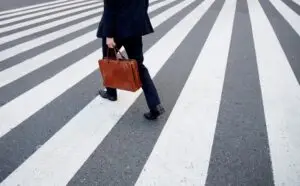
For example, busy cities such as Los Angeles, San Francisco, and Sacramento often feature pedestrian countdown timers, leading pedestrian intervals, flashing beacons, and dedicated crossing signals. These traffic control devices may provide additional evidence when determining whether a driver or pedestrian followed the applicable traffic laws.
Also, some suburban and rural roads have few marked crosswalks, even though unmarked crosswalks may still exist at intersections. In these situations, investigators may examine the roadway layout, traffic signs, visibility, and other conditions to determine whether the pedestrian had the right of way.
We regularly investigate pedestrian accidents across California and understand how roadway design, traffic control devices, and local conditions affect liability. We begin these cases with a careful review of the facts rather than relying on the insurer’s version of who was at fault.
How Is Fault Determined After a Pedestrian Accident?
Fault is determined by assessing the evidence surrounding the collision rather than relying on one person’s version of events. Insurance companies, attorneys, and accident investigators evaluate multiple sources of evidence to understand what happened before, during, and after the collision.
Common evidence includes:
- Traffic camera footage
- Surveillance video from nearby businesses
- Photographs of the accident scene
- Eyewitness statements
- Police reports
- Vehicle event data recorder information
- Cellphone records, when available
- Medical records documenting the injuries
Each piece of evidence helps answer different questions. For instance, video footage may show whether the pedestrian entered the crosswalk with the walk signal, while witness statements may explain whether the driver appeared distracted or failed to stop. Also, medical records can connect the collision to the injuries suffered, and accident reconstruction professionals may use physical evidence to determine vehicle speed, braking, and impact angles.
Some forms of evidence tend to disappear quickly. Therefore, it is advisable to act promptly after a pedestrian accident to preserve information that may become important later in an insurance claim or lawsuit.
How Does Comparative Negligence Affect a Pedestrian Accident Claim?
In California, pedestrians injured in traffic accidents can still get money even if the accident was partly their fault. The state uses a system called pure comparative negligence, which just reduces your final payout by your percentage of blame.
Let us explain:
Example One
A pedestrian crosses outside a crosswalk while a driver is traveling 15 mph over the speed limit. A jury determines the pedestrian is 30 percent liable and the driver is 70 percent responsible. If the pedestrian’s damages total $200,000, they may still recover $140,000.
Example Two
A pedestrian enters a crosswalk while looking at a cellphone instead of watching traffic. At the same time, a driver fails to yield while making a right turn. The pedestrian is found 20 percent liable, and the driver is 80 percent at fault. The pedestrian’s compensation is reduced by 20 percent rather than denied altogether.
Insurance companies frequently argue that a pedestrian shares more fault than the evidence supports because even a small increase in comparative negligence can reduce the amount paid on a claim. Many claimants benefit from hiring a pedestrian accident attorney to investigate the accident and present a more complete picture of how the collision occurred.
California’s Pedestrian Right-of-Way Laws May Affect Your Case

A pedestrian accident claim can turn on much more than whether you were in a crosswalk. California’s comparative negligence rules can influence who is liable and what compensation is available.
At M&Y Personal Injury Lawyers, we represent injured pedestrians throughout California and know the issues that arise in right-of-way disputes. We investigate accidents thoroughly, work to preserve evidence, and advocate for you in insurance negotiations and litigation when needed.
If you or a family member was injured in a pedestrian crash in California, call M&Y Personal Injury Lawyers at 866-864-5477 for a free consultation. We can review the details of your case and the legal options available to you.
FAQs: Pedestrian Right-of-Way Laws in California
The following answers address additional questions that frequently arise when handling accident claims involving pedestrians:
Can a pedestrian receive a traffic citation after an accident?
A pedestrian who violates certain California traffic laws, such as crossing against a traffic signal or failing to yield when crossing outside a crosswalk, may receive a citation depending on the circumstances. Receiving a citation does not automatically prevent an injured pedestrian from pursuing a personal injury claim, but it may become one factor considered when determining liability.
What if the driver says they never saw me?
A driver saying they did not see a pedestrian does not automatically relieve them of liability. Drivers are expected to remain attentive to road conditions, intersections, and pedestrians who may be crossing lawfully. Your lawyer will review the available evidence, such as surveillance footage, to help determine whether the driver exercised reasonable care.
Do pedestrians have the right of way in parking lots?
Parking lots are generally governed by rules different from those for public roadways because they are private property. Even so, drivers still have a duty to operate their vehicles with reasonable care and avoid striking pedestrians. Liability depends on the specific circumstances, including the actions of everyone involved and the design of the parking lot.
Does wearing dark clothing affect a pedestrian accident claim?
Wearing dark clothing does not automatically make a pedestrian responsible for an accident. However, insurance companies may argue that visibility was a factor, particularly if the collision occurred at night or in poor weather conditions. An investigation can determine whether the driver’s speed, attentiveness, or other factors played a greater role in causing the collision.
What if my insurer is pushing me to accept a settlement offer?
Many people choose to speak with an attorney before accepting a settlement. Accepting early settlements may affect your ability to seek additional compensation should extra needs arise later. An attorney can review the available evidence, explain how California’s pedestrian right-of-way laws apply to the accident, and discuss the legal options available based on the facts of the case.
What if I were struck by a vehicle while walking along the shoulder of the road?
Drivers who hit pedestrians on a shoulder are typically liable for failing to maintain a safe distance or for inattention. However, whether the pedestrian acted reasonably depends on the specific circumstances, including the road design, available walking space, and surrounding traffic conditions. An investigation can help determine whether the driver, the pedestrian, or both contributed to the collision.
What happens if a pedestrian accident involves more than one vehicle?
Some pedestrian accidents involve multiple vehicles, making liability more complex. More than one driver may share responsibility if their actions contributed to the collision or created the circumstances that led to the pedestrian’s injuries. A thorough investigation can help determine how fault should be allocated among everyone involved.