Key Takeaways:
- California is the only state with a statute that expressly recognizes motorcycle lane splitting, but riders must do so safely based on the surrounding traffic and roadway conditions.
- Motorcyclists who are lane splitting and drivers sharing the road both have legal duties to exercise reasonable care and avoid actions that increase the risk of a collision.
- Lane splitting does not automatically make a motorcyclist responsible for an accident. Liability turns on the facts of the crash, the conduct of everyone involved, and the available evidence.
- If a lane-splitting accident results in injuries, evidence such as witness statements, traffic camera footage, vehicle damage, and the police report may help determine how the collision occurred.
What Is Motorcycle Lane Splitting?
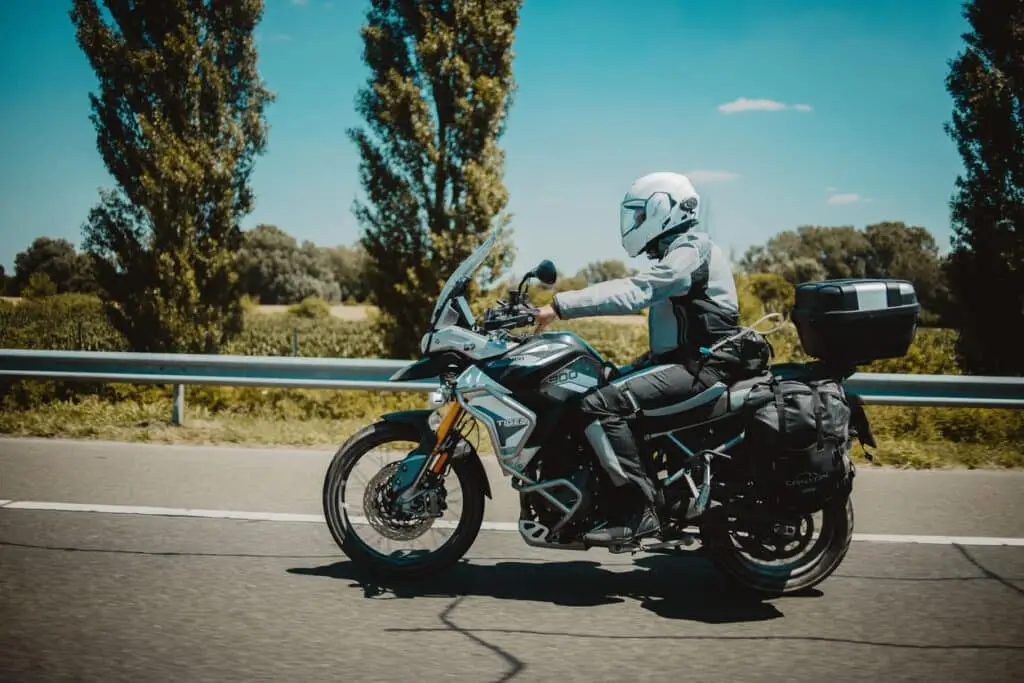
Motorcycle lane splitting involves riding between stopped or moving vehicles traveling in the same direction. Instead of remaining fully within a single lane, the motorcyclist travels in the space between adjacent lanes of traffic.
Under California Vehicle Code § 21658.1, lane splitting means driving a motorcycle between rows of stopped or moving vehicles traveling in the same direction. The statute also authorizes the California Highway Patrol (CHP) to develop and publish educational guidelines to promote the safe practice of lane splitting.
Sometimes, people confuse lane splitting and lane filtering. Although the terms are sometimes used interchangeably, lane splitting and lane filtering describe different riding maneuvers.
- Lane splitting involves riding between lanes of moving or stationary traffic traveling in the same direction.
- Lane filtering generally refers to a motorcyclist moving between stopped traffic to reach the front of the line at an intersection or traffic signal.
California law specifically recognizes lane splitting but does not separately define or regulate lane filtering. In practice, whether a maneuver is called lane splitting or lane filtering, the rider must still operate the motorcycle with reasonable care under the circumstances.
Is Lane Splitting Legal in California?
Lane splitting is legal in California and has been since January 1, 2017. Before that date, the practice existed in a gray area because it wasn’t explicitly banned but wasn’t formally recognized in the Vehicle Code, leaving riders exposed to inconsistent enforcement across counties.
Assembly Bill 51, signed by then-Governor Jerry Brown in August 2016, changed that by adding Section 21658.1 to the Vehicle Code. California remains the only state that permits full lane splitting between both moving and stopped traffic. However, several other states have since legalized lane filtering, which applies only to stopped or very slow-moving traffic.
California formally recognized lane splitting to provide clarity for motorcyclists, drivers, law enforcement, and insurers. Before California Vehicle Code § 21658.1 took effect, lane splitting was not expressly prohibited, but there was no statute defining the practice or authorizing the CHP to issue safety guidance.
The law does not give motorcyclists unlimited authority to ride between vehicles whenever they choose. Instead, it acknowledges that lane splitting may be performed legally while making clear that riders must consider traffic speed, roadway conditions, weather, and other circumstances that affect whether the maneuver can be completed safely.
What Rules Apply When Motorcycles Are Lane Splitting in California?
 California law allows motorcycle lane splitting, but riders must consider the conditions around them when deciding whether the maneuver can be performed safely. Although California Vehicle Code § 21658.1 does not establish specific lane-splitting requirements, the California Highway Patrol provides educational guidance addressing factors that may affect the safety of the practice.
Riders Should Consider Traffic Speed and Conditions
Traffic speed is one of the most important factors affecting a lane-splitting maneuver. A motorcycle traveling significantly faster than surrounding vehicles may have less time to react if a driver changes lanes, opens a door, or moves unexpectedly.
Riders should evaluate whether traffic conditions allow enough space to travel between vehicles safely. Congested highways, sudden traffic slowdowns, and unpredictable vehicle movements can create additional hazards for motorcycles traveling between lanes.
Riders Should Maintain a Safe Speed
California does not create a separate speed limit for lane splitting, but motorcyclists must still follow general speed laws. Under California Vehicle Code § 22350, drivers must operate at a speed that is reasonable and prudent under the circumstances.
The appropriate speed depends on factors such as traffic flow, roadway conditions, visibility, and the amount of space available between vehicles. A motorcycle traveling at an unsafe speed may face liability questions if a collision occurs.
Riders Should Consider Lane Width and Available Space
Vehicle Code Section 21658 requires drivers to stay within a single lane until they can move out of it safely. The space between lanes can vary significantly depending on the roadway, vehicle sizes, and traffic patterns. For instance, a motorcycle that has enough room to pass safely in one location may not have the same amount of space in another.
Large vehicles, including commercial trucks and buses, may create additional challenges because they have larger blind spots and require more room to maneuver. Riders should account for these conditions when deciding whether lane splitting is appropriate.
Riders Should Remain Aware of Surrounding Vehicles
Drivers may not always expect a motorcycle to travel between lanes of traffic. Motorcyclists should remain alert to vehicles that may merge, change lanes, or move through gaps in traffic.
Similarly, drivers should check their surroundings before changing lanes and avoid actions that interfere with a motorcycle operating lawfully. Awareness from both motorcyclists and drivers can reduce the likelihood of a collision.
Lane splitting requires judgment based on the circumstances at the time of the maneuver. When a crash occurs, investigators may review these factors along with other evidence to determine how the collision happened.
Drivers’ Responsibilities Toward Lane-Splitting Motorcyclists
California law requires all motorists to exercise reasonable care when sharing the road, including when motorcycles are lawfully lane splitting. Drivers do not have greater rights to the roadway simply because a motorcycle is traveling between lanes, and their actions may be examined if a collision occurs.
Here are some responsibilities for drivers:
Drivers Must Check Blind Spots Before Changing Lanes
Drivers should check their mirrors and blind spots for approaching motorcycles before moving into another lane. Because motorcycles are smaller compared to passenger vehicles, they may be more difficult to see, particularly in congested traffic where lane splitting is more common.
A driver who changes lanes without first checking for a nearby motorcycle may increase the risk of a collision. Investigators may review witness statements, dash camera footage, and vehicle damage to determine whether the driver exercised reasonable care before changing lanes.
Drivers Should Not Intentionally Block a Lane-Splitting Motorcycle
California law does not allow motorists to deliberately interfere with a motorcycle that is lawfully lane splitting. Intentionally blocking a rider’s path, crowding the rider, or making sudden movements to prevent passing can create unnecessary hazards.
Drivers are not required to move out of a motorcyclist’s way, but they should keep driving predictably and avoid actions that raise the risk of a collision.
Drivers Should Signal Before Changing Lanes
Using turn signals gives surrounding motorists, including motorcyclists, advance notice that a vehicle intends to change lanes. This additional warning can help riders adjust their speed or position before the maneuver is completed. Failing to signal does not automatically establish liability, but it may become one factor considered when determining how a lane-splitting accident occurred.
Notably, safe lane splitting depends on the actions of everyone using the roadway. Motorcyclists should evaluate traffic conditions before riding between lanes, while drivers should remain alert for motorcycles and avoid sudden lane changes or other unexpected maneuvers. When a lane-splitting accident occurs, investigators consider the conduct of both parties rather than assuming one driver is automatically at fault.
What to Do After a Lane-Splitting Motorcycle Accident
The steps you take after a lane-splitting motorcycle crash can influence both your recovery and your ability to pursue a personal injury claim. Because these cases frequently involve disputes over the motorcycle’s speed, lane position, and the actions of nearby drivers, preserving evidence immediately after the crash is especially important.
- Contact law enforcement as soon as possible and request an officer to visit the scene.
- If it is safe to do so, capture photographs of the collision scene before the vehicles are moved.
- Obtain witnesses’ contacts, as they can provide key details about the events leading up to the crash.
- Do not admit fault or assume that lane splitting automatically caused the collision.
- Seek medical evaluation as soon as possible. A prompt visit creates records that document your injuries and connect them to the collision.
- Consult a motorcycle accident attorney to untangle complex questions about traffic laws, insurance coverage, and liability.
Acting quickly after a lane-splitting motorcycle accident also gives you more time to build a strong claim. Evidence can disappear, witnesses’ memories may fade, and surveillance footage may be overwritten within days or weeks. In addition, California law generally gives injured motorcyclists two years from the date of the accident to file a personal injury lawsuit, under Code of Civil Procedure Section 335.1.
Protect Your Rights After a Lane-Splitting Motorcycle Accident
 A motorcycle accident involving lane splitting can raise unique legal questions. Sorting out what happened means examining the actions of everyone involved and all the evidence available after the crash.
At M&Y Personal Injury Lawyers, we identify the facts that matter most to your claim. We look past the assumption that lane splitting automatically determines fault and dig into the factors that actually decide liability under California law.
Call M&Y Personal Injury Lawyers at 866-864-5477 for a free consultation. You pay nothing unless we recover compensation for you.