
Why Does the Crossing Location Matter After a San Jose Pedestrian Crash?
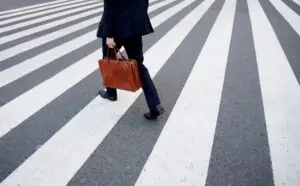 Crossing location matters because California applies different rules to marked and qualifying unmarked crosswalks, sidewalks, driveways, and mid-block crossings. The location helps determine what duties applied to the pedestrian and driver and what the evidence must establish.
What Does California Law Require When a Driver Approaches a Pedestrian?
California Vehicle Code § 21950 requires drivers to yield to pedestrians who are crossing within any marked crosswalk or within an unmarked crosswalk at an intersection. The statute also requires an approaching driver to exercise due care and reduce speed or take other necessary action to safeguard the pedestrian.
Section 21950 is not one-sided. It also requires pedestrians to use due care and prohibits a pedestrian from suddenly leaving a curb or other place of safety and walking or running into the path of a vehicle that is so close that it creates an immediate hazard.
That two-sided structure is exactly what makes these claims contested. The driver says the pedestrian appeared too suddenly. The pedestrian says the driver had plenty of time to yield. The crossing location, signal status, vehicle speed, and available sight lines determine which account the evidence supports.
What Does “Exercise Due Care” Mean for a Driver?
Due care requires a driver approaching a pedestrian in a marked or unmarked crosswalk to reduce speed or take other action when necessary for the pedestrian’s safety. The pedestrian’s own duty of care remains part of the analysis.
What if I Was Hit While Crossing Outside a Crosswalk?
 Crossing outside a crosswalk does not automatically eliminate a pedestrian injury claim. Vehicle Code § 21954 requires a pedestrian crossing outside a marked or qualifying unmarked crosswalk to yield to vehicles that are close enough to create an immediate hazard. The same statute expressly states that this rule does not relieve a driver of the duty to exercise due care for any pedestrian on the roadway.
Vehicle Code § 21955 also continues to require pedestrians traveling between adjacent signal-controlled intersections to cross within a crosswalk.
AB 2147 changed the enforcement approach by generally prohibiting police from stopping a pedestrian for these violations unless a reasonably careful person would recognize an immediate collision danger.
The practical effect is that both the pedestrian’s duty to yield and the driver’s continuing duty of care are evaluated under the actual traffic conditions. A pedestrian crossing mid-block on a multilane San Jose road still faces a comparative-fault analysis, but the driver’s speed, attention, and opportunity to yield are part of that same analysis.
How Does Evidence Show Whether the Driver Had Time to Yield?
Pedestrian claims often require reconstructing when the driver first saw the person and what opportunity existed to respond. The investigation organizes the available roadway, vehicle, witness, and video evidence around four stages:
|
Moment in the Crash |
What the Investigation Needs to Establish |
|
Before crossing |
Where the pedestrian and vehicle were, signal status, sight lines, and traffic conditions |
|
Entering the crossing |
When the pedestrian became visible and how the vehicle was approaching or turning |
|
Paths converge |
Available stopping or yielding opportunity and the location of contact |
|
After impact |
Vehicle and pedestrian positions, physical evidence, witness observations, and documented injuries |
Vehicle damage location tells part of the story. A pedestrian struck by the front bumper at low height presents a different damage pattern than a pedestrian who contacted the vehicle’s side panel during a turning movement. The damage height, location, and pattern narrow where each party was at the moment of impact.
Business surveillance, traffic cameras, and residential doorbell cameras along San Jose commercial corridors and intersections can contain relevant footage of pedestrian collisions. M&Y identifies potential camera sources early because footage is overwritten on varying schedules.
Do You Need a Lawyer After a San Jose Pedestrian Accident?
 A pedestrian claim becomes harder to resolve when the parties disagree about the crossing itself: whether a crosswalk existed at that location, which signal controlled the pedestrian, when the driver first saw the person, or whether the pedestrian entered traffic too suddenly. Those questions require matching specific California statutes against the physical evidence from the crash site.
Situations that benefit from legal preparation include significant injuries requiring extended treatment, a disputed crosswalk or unmarked-crossing location, and a turning-vehicle crash where the driver claims the pedestrian was not visible. A hit-and-run where the vehicle must be identified, a nighttime collision with disputed visibility, or substantial future medical or employment losses also add complexity to the claim.
M&Y maps the crossing, obtains available video and signal information, documents pedestrian and vehicle positions, reviews police records, and compares the driver’s statements against the physical evidence. For injury claims beyond pedestrian accidents, M&Y’s San Jose personal injury lawyers handle car, truck, motorcycle, bicycle, and other claims across Santa Clara County.
How Does M&Y Build a San Jose Pedestrian Claim?
M&Y builds pedestrian claims around what the driver had an opportunity to see and what California law required at that particular crossing. The firm determines whether the location qualifies as a marked crosswalk, an unmarked crosswalk, a sidewalk crossing, or a mid-block location, and then applies the statute that governs the driver’s duty at that site.
M&Y has recovered over $1 billion for California injury victims. Every client works directly with an attorney, and the firm also handles pedestrian claims through its Los Angeles pedestrian accident practice and other California offices.
You pay no attorney fees unless we recover compensation. Contact us or call 866-864-5477 for a free consultation.
A Pedestrian Claim Turns on a Short Window of Time
 When the person entered the crossing, when the driver first saw them, what the signal displayed, and how much distance remained before their paths met are the facts that decide a San Jose pedestrian accident claim. M&Y Personal Injury Lawyers assembles those details into one documented account of what happened and who bears responsibility.
Contact M&Y Personal Injury Lawyers or call 866-864-5477 for a free consultation. You pay no attorney fees unless we recover compensation. We are available 24/7.