Free Consultation, Talk to a Real Lawyer Now.

Los Angeles Pedestrian Accident Lawyer/School Zone

Twice every school day, the streets around Los Angeles campuses fill with the two things that mix worst on a road: hurried drivers and small children. Drop-off and dismissal compress thousands of crossings into a half hour, and when a driver gets it wrong, the person hurt is usually a child. M&Y Personal Injury Lawyers represents families whose children were injured in school zone accidents across Los Angeles, and a school zone accident lawyer from our firm can explain, in one free conversation, the protections the law gives your child and how we put them to work.

If a driver hurt your child near a school, contact us now. The consultation costs nothing, and no fee applies unless we win your family’s case.

Table of Contents

What Speed Limits and Laws Protect Los Angeles School Zones?

The core protection is a 25 mph limit that activates around schools, and it binds drivers whether or not a sign reminds them. Under Vehicle Code Section 22352, the presumed legal limit, what’s called the prima facie limit, drops to 25 mph when passing a school while children are outside or crossing, and local authorities can post zones as low as 15 mph on the narrowest streets. “While children are present” is read broadly, covering arrival, recess, dismissal, and the walking window around them.

Los Angeles has been layering protections on top of the statute. The city has lowered posted limits on streets around dozens of campuses, and school zones sit at the center of the new automated speed camera pilot, precisely because speed decides whether a struck child survives. A car needs meaningfully less distance to stop at 25 mph than at 40, and the injury difference between those speeds is the difference between a broken arm and a funeral.

For your child’s case, the zone does one more quiet job. A driver speeding through an active school zone has violated a statute written specifically to protect children, and that violation anchors the negligence claim from the first filing the kind of statutory violation a pedestrian accident lawyer relies on to establish fault early.

Drivers Owe Children More Care Than They Owe Adults

California law has said for generations that a driver who knows children may be near must expect them to act like children. Courts recognize that kids misjudge speed and distance, follow balls into streets, and trust crossing adults would double-check, so the reasonable driver near a school anticipates the sudden dart rather than merely reacting to it. Extraordinary care around children is the standard, not a courtesy.

The flip side protects your child, too. Young children are not held to an adult’s judgment, and children under five cannot legally be negligent at all, so an insurer’s instinct to blame a seven-year-old for crossing carelessly runs into a wall of settled law. Older children are measured against a child of similar age and experience, not against a cautious adult.

Those two doctrines together reframe most school zone cases. The driver owed more care than usual, the child owed less than an adult would, and the fault analysis starts from that tilt.

Where School Zone Crashes Actually Happen

The danger is not spread evenly around a campus, and the crash patterns repeat at schools from Boyle Heights to the West Valley. The scenarios we see most:

  • The drop-off double-park, where a child steps out from between stopped cars and a passing driver accelerates around the line of stopped traffic.
  • The mid-block dart, on the walking routes a block or two from campus, where children cross where the path is shortest rather than where the paint is.
  • The passing school bus, since Vehicle Code Section 22454 requires traffic in both directions to stop for a bus’s flashing red lights, and drivers who blow past them meet children crossing to the door.
  • The crossing guard rollup is when a driver inches into or around a guarded crosswalk while children are still in it.
  • The parking lot and driveway strike, in the campus lot itself, where reversing SUVs and small children share blind space.

Each pattern carries its own proof, from bus camera footage to the guard’s own account. Placing your child’s crash in its pattern is one of the first things we do, because it tells us which evidence to chase before it disappears.

How We Prove What Happened to Your Child

School zones are among the best-documented stretches of road in Los Angeles, and we treat that as the case’s first advantage. Campuses run exterior cameras that cover gates and pickup lanes, school buses carry their own cameras facing forward and along the passenger door, and the surrounding blocks hold the doorbell and storefront systems every busy street does. Our preservation letters go out to the school, the district’s transportation office, and the neighboring properties in the first days, before retention cycles erase the recording that shows the whole event.

Witnesses

The adult witnesses in a school zone are unusually valuable, and we reach them early. Crossing guards can speak to the driver’s speed and their own signals with an authority that jurors respect; teachers and aides on dismissal duty saw the traffic pattern daily and know what was different that afternoon; and other parents in the queue often watched the entire sequence from a stopped car. Children’s own accounts are handled gently and through the right professionals, never by pressuring a hurt kid to relive the worst moment of their life.

If your child was hurt near a school, call 866-864-5477 now, while the footage and records that prove it still exist.

Event Data

The technical layer completes the file. The driver’s vehicle carries event data showing speed and braking in the final seconds, the school’s own safety plan and bell schedule establish that children were present as a matter of record, and reconstruction work accounts for something adult-focused analysis misses: a child’s height, and what the driver could actually see over a hood or between parked cars. When the district’s procedures are part of the problem, its prior incident reports and guard-staffing records come in through the government claim.

Built that way, the file answers the question insurers prefer to leave vague. It shows precisely where your child was, what the driver should have seen and done, and how far short of that duty they fell.

How Is an Injury Claim Different When the Victim Is a Child?

Almost everything has procedural changes, starting with time. A minor’s injury claim is tolled under Code of Civil Procedure Section 352, meaning the two-year clock generally does not begin until the child turns 18, so the deadline that pressures adult cases relaxes here. One sharp exception survives, and it appears in the next section, because claims involving public entities keep their short fuse even for children.

Settlement works differently, too. A child cannot sign away legal rights, so California requires court approval of any minor’s settlement through a proceeding called a minor’s compromise, where a judge reviews whether the amount and the attorney’s fees are fair to the child. Approved funds are then protected, typically in a blocked account that the child receives at 18 or in a structured arrangement that pays out over time.

Parents keep their own claim alongside the child’s in serious cases, since a family can recover medical expenses they paid and, in the worst cases, wrongful death damages. We handle the two tracks together, so nothing owed to the family gets left inside the child’s claim or outside it.

Can the School or District Share Responsibility?

Sometimes, because schools owe students supervision, the walk between the gate and the curb is where that duty meets traffic. A district that dismisses hundreds of children into an unmanaged pickup scrum, removes a crossing guard from a crossing it knows is dangerous, or designs a drop-off loop that routes kids between moving cars can share fault with the driver who struck your child. These claims turn on what the school knew and what its own safety plans required.

The trap is the deadline. A claim against a school district or city must be presented under the Government Claims Act within six months of the injury, per Government Code Section 911.2, and the tolling that protects a child’s claim against the driver does not excuse missing this presentation window. Families who wait to “see how recovery goes” can silently lose the school’s share of responsibility.

So we evaluate the school’s role in every school zone case immediately. Dismissal procedures, guard assignments, prior incident records, and the campus traffic plan tell us within weeks whether your child’s case has one responsible party or two.

What a Child’s Injury Claim Must Account For

A child’s damages run on a longer clock than an adult’s, and valuing them correctly is where these cases are won. A fracture, a head injury, or scarring can affect a child differently than an adult, sometimes not showing its full impact until years later as your child grows. The claim must fund not just the treatment already given but the care, monitoring, and interventions the injury will demand across a lifetime.

The non-medical losses are real and compensable, too. Pain, fear of streets and cars, withdrawal from sports and play, and the counseling that helps a child process being hit by a car all belong in the demand, supported by the professionals treating your child rather than by adjectives.

We build these valuations with pediatric specialists, life-care planners, and the people who know your child best. A settlement that looks large today and runs out at 22 is a failure, and we structure our demands so it cannot happen.

A Firm Built for the Cases Families Bring

Parents arrive at our door on the worst week of their lives, and the way a firm treats them in that week tells you everything. At M&Y Personal Injury Lawyers, an attorney, not a case manager, handles your child’s case personally from the first call through the final court approval, explains every step in plain language, and answers when you call at 9 p.m. because the school sent a letter. That is how our founders built this firm in 2013, and it is why so many of our cases arrive as referrals from former clients.

Our offices sit across Los Angeles, in the same communities where these crashes happen, and that proximity shapes how we work a case from day one.

The results side is equally built for these cases. We have recovered more than $800 million for injured Californians. Results may vary. Prior case outcomes do not guarantee similar results.

Our team of over 100 includes attorneys with a century of combined courtroom experience, and we carry the resources that lifetime-damages personal injury cases against insurers and school districts demand.

Your consultation is free, our line answers 24/7, and no fee exists unless we win. Let us take the legal weight while you carry your child.

FAQs: School Zone Accidents in Los Angeles

Parents ask us versions of the same questions in nearly every one of these cases, and the honest answers are here.

Very likely yes, because drivers near schools are legally required to anticipate exactly that behavior, and young children are judged by a child’s capacity rather than an adult’s. Fault may be shared in some percentage, and California’s comparative system reduces rather than eliminates recovery. The younger the child and the more active the school zone, the less traction the darting argument gets.


Neither freely, by design. The court approves the settlement, and the child’s share typically goes into a blocked account or structured payments the child accesses at 18, protecting the funds from everyone, including well-meaning parents facing bills. Amounts the family itself owes, like medical costs a parent paid, are separated out and paid to the parents directly.


The 25 mph statute applies when passing the school itself, but the heightened duty to expect children follows the children, not the signage. A driver on a known walking route at dismissal time owes care matched to the kids visibly using it. We treat the walking corridor as part of the case, including whether the school directed students along it.

No, older minors are held to the judgment of a reasonable teenager of similar age and experience, which is more than a seven-year-old and less than an adult. Insurers push harder on comparative fault with teens, especially around phones and headphones. The driver’s duties in an active school zone remain fully intact regardless of the pedestrian’s age.

Waiting costs evidence even when it does not cost the claim, and it can cost the claim where a school or city is involved, because the six-month government deadline is not paused. Camera footage, witness memories, and dismissal-procedure records all decay within months. The tolling protects your child’s rights, and acting early protects the proof that those rights depend on.


Yes, psychological treatment is medical care, and the emotional harm itself is a compensable injury alongside the physical ones. Counseling records also document how the crash changed your child, which supports the full claim. Getting your child the help promptly serves their recovery first and the case second, in that order.

Your Job Is Being Their Parent. Ours Is Everything Else

Team of lawyersThe hospital visits, the school letters, the adjuster calling your cell, the six-month clock ticking on a district claim- none of it should fall on a parent already holding a hurt child. M&Y Personal Injury Lawyers takes all of it, builds the case your child’s future actually requires, and charges nothing unless we win it.

Call 866-864-5477 any hour, or reach us through our contact page, and hand the legal part to us today.

What Our Clients Say About Us – Client Review
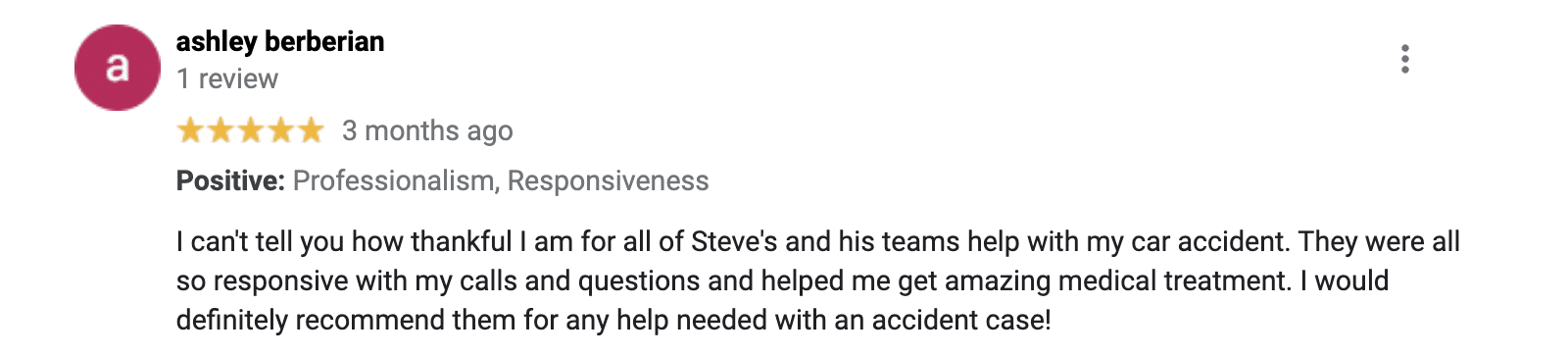
Client Review

https://goo.gl/maps/hiKpNX8D5Gkh4KZ58

Read more of our reviews here.
Los Angeles Office Location

Visit our headquarters in LA to get the assistance you need, our law firm is located at 6300 Wilshire Blvd #960, Los Angeles, CA 90010.

Los Angeles Office Location

Visit our headquarters in LA to get the assistance you need, our law firm is located at 6300 Wilshire Blvd Suite 807, Los Angeles, CA 90048.

Highly Rated Local Auto Repair Shops Near You

  • J&S Onestop Auto Repair, Inc. – 4220 W Olympic Blvd, Los Angeles, CA 90019
  • Hans Beverly Auto – 4670 Beverly Blvd, Los Angeles, CA 90004

*Disclaimer – we do not endorse these companies or profit from having them listed on our website.

Car Accident Infographic

SEARCH OUR SITE

OUR OFFICES

Los Angeles - Main Office

6300 Wilshire Blvd. Suite 807
Los Angeles, CA 90048
Los Angeles Law Office Map

6300 Wilshire Blvd. Suite 807
Los Angeles, CA 90048
Los Angeles Law Office Map

350 S Figueroa St. Suite 276
Los Angeles, CA 90071
Downtown Los Angeles Law Office Map

Call: (877) 751-8953

402 W. Broadway #400
San Diego, CA 92101

Call: (619) 404-2797

2400 E Katella #800
Anaheim, CA 92806

Call: (714) 386-7623

8050 N. Palm Ave. #300
Fresno, CA 93711

Call: (559) 853-4863

6360 Van Nuys Blvd. #219
Van Nuys, CA 91401

Call: (213) 296-1243

11801 Pierce Street #200
Riverside, CA 92505

Call: (951) 234-5468

99 S Almaden Blvd #600
San Jose, CA 95113

Call: (408) 617-8928

111 West Ocean Blvd. #400
Long Beach, CA 90802

Call: (562) 354-8219

473 E. Carnegie Drive #200
San Bernardino, CA 92408

Call: (818) 650-3861