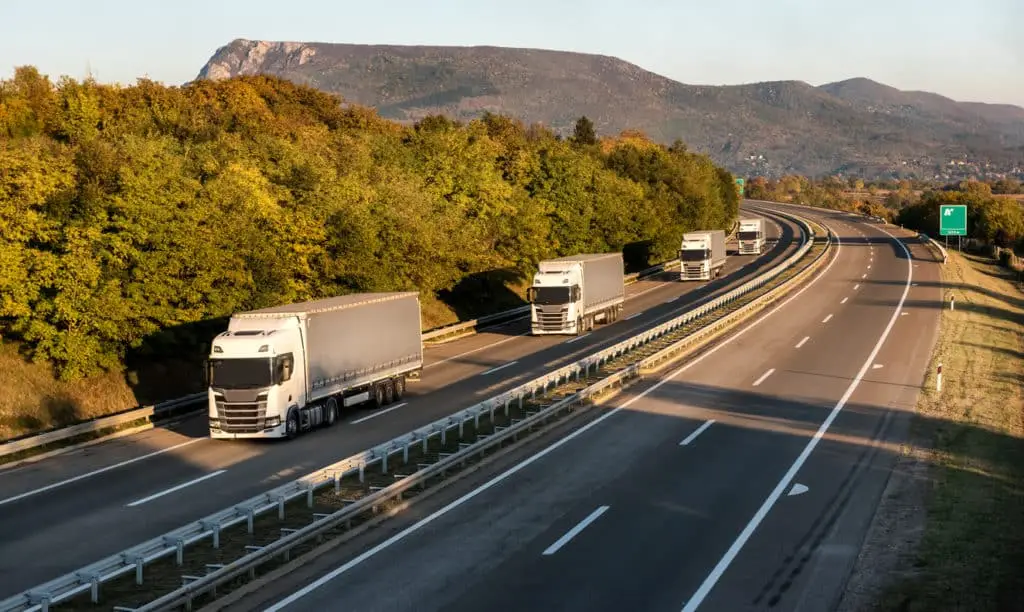
The Bottom Line on Truck Speed Limits
- California caps trucks with three or more axles, and trucks towing another vehicle, at 55 mph on all highways.
- The 55 mph limit applies even on highways posted at 65 or 70 mph for passenger cars.
- Smaller trucks with two axles that are not towing anything generally follow the posted limit.
- A truck driver who violates a speed law can be presumed negligent if the violation helped cause the crash.
- Every driver, including truckers, must also slow below the limit when weather, traffic, or visibility make the limit unsafe.
Which Trucks Must Stay at 55 MPH in California?
California’s Vehicle Code 22406 sets a 55 mph maximum for heavy and high-risk vehicles. The rule turns on axles, towing, and cargo, not on whether the vehicle is used for business.
Vehicle | Subject to the 55 mph limit? |
|---|---|
Truck or truck tractor with three or more axles | Yes |
Any truck or truck tractor towing another vehicle | Yes |
Two-axle box truck or delivery truck not towing anything | No, the posted limit applies |
Vehicle transporting explosives | Yes |
School bus carrying students | Yes |
Farm labor vehicle carrying passengers | Yes |
This means a typical tractor-trailer is always limited to 55 mph, while a two-axle delivery van usually is not. When a crash involves a commercial vehicle, its axle count and whether it was towing are among the first facts to confirm.
How to Tell Whether a Truck Was Covered
Photos of the truck at the scene usually answer the question. Counting the axles on the tractor, noting any trailer or towed equipment, and recording the company name and USDOT number on the cab help establish which speed rule applied.
Does the 55 MPH Limit Apply on 65 and 70 MPH Highways?
 The 55 mph truck limit applies on every California highway, including freeways where passenger cars may legally drive 65 or 70 mph.
Posted Limits Do Not Override the Truck Limit
California sets a general maximum of 65 mph and allows 70 mph only on highways that are posted for it.
Those higher posted limits apply to passenger vehicles, so a truck driver cannot rely on a 70 mph sign to justify driving faster than 55. A truck traveling 70 in that lane is 15 mph over its own limit, even while it keeps pace with the cars around it.
When Even 55 MPH Is Too Fast
California’s basic speed law prohibits driving faster than is reasonable or prudent for the conditions. A truck can be traveling under 55 mph and still be driving unsafely, especially in conditions such as:
- Fog, rain, or wind that reduces visibility or traction.
- Heavy or stop-and-go traffic.
- Construction zones and lane closures.
- Steep downgrades where brakes can overheat.
- Poorly lit roads at night.
A trucking company cannot defend a crash simply by showing the driver stayed under the numerical limit. The question is whether the speed was safe for the road at that moment.
How Does Truck Speeding Prove Negligence?
Truck speeding can prove negligence through a rule called negligence per se. When a driver violates a safety statute such as the 55 mph limit and that violation was a substantial factor in causing a crash, the law presumes the driver was negligent.
The Presumption of Negligence
California’s Evidence Code 669 presumes a driver failed to use reasonable care when four things are true: the driver broke a safety law, the violation helped cause the injury, the injury was the kind the law was meant to prevent, and the injured person was someone the law protects.
Under the state’s jury instruction, the injured person must still show that the violation was a substantial factor in causing the harm.
What the Presumption Looks Like in Practice
Suppose a loaded tractor-trailer traveling 68 mph on a highway rear-ends a car that slowed for traffic ahead. The truck’s speed violated the 55 mph limit. The extra stopping distance at 68 mph helps show the violation contributed to the crash, which supports the presumption of negligence.
How the Trucking Company Can Respond
The presumption is strong, but it is not an automatic win. A trucking company may argue the driver was not actually speeding, that the speed did not contribute to the crash, or that the violation was excused by circumstances beyond the driver’s control.
A Speeding Ticket Is Not Required
A truck accident claim does not depend on whether the police wrote the truck driver a ticket. Speed can be proven with the truck’s electronic data, reconstruction, video, and witness accounts, even when no citation was issued at the scene.
Who Pays When a Speeding Driver Causes a Crash?
A trucking company is generally responsible for crashes caused by its drivers while working, so its commercial insurance is usually the primary source of payment. If the company pressured the driver with unrealistic schedules, it may also face direct responsibility for its own conduct. A Los Angeles truck accident lawyer can identify every party whose decisions contributed to the speed.
Why Is Speed More Dangerous in a Loaded Truck?
Speed is more dangerous in a loaded truck because a heavier vehicle needs much more distance to stop and hits with far greater force. A fully loaded tractor-trailer can weigh many times more than a passenger car.
Weight and Stopping Distance
Federal rules allow trucks on the interstate system to weigh up to 80,000 pounds gross vehicle weight. Understanding how much a loaded semi truck weighs helps explain why a truck going even 10 mph too fast may not be able to stop before reaching slowed traffic.
Why the Injuries Are More Severe
The added force of a heavy truck at high speed often turns a survivable collision into a catastrophic one. Underride crashes, rollovers, and multi-vehicle pileups are more likely when a truck is traveling too fast for the conditions.
People in smaller vehicles absorb most of that force, which is why truck crashes so often lead to life-changing injuries and long recoveries.
Following Distance on Two-Lane Roads
On two-lane roads outside business and residential districts, California’s following distance rule requires a truck subject to the 55 mph limit to stay at least 300 feet behind another such truck. The rule does not apply on highways with two or more lanes in the same direction, but it reflects the same concern about stopping room.
Penalties for Truck Drivers Who Speed
A truck driver who speeds risks fines, points on their driving record, and the loss of their commercial driving privileges. Repeated violations can take a driver off the road entirely.
Commercial License Disqualification
Federal rules treat driving a commercial vehicle 15 mph or more over the regulated or posted limit as a serious traffic violation. A second serious violation within three years leads to a 60-day disqualification, and a third leads to 120 days.
Why a Driver’s History Matters to an Injury Claim
A pattern of speeding tickets can be relevant to more than the driver. If a trucking company hired or kept a driver with a record of serious violations, that history may support a claim that the company itself was negligent.
Related Truck Rules on California Highways
Speed is only one of several rules that keep heavy trucks separated from faster traffic. The truck lane restrictions in California work alongside the 55 mph limit by keeping trucks to the right, where slower traffic belongs.
When Speed and Lane Violations Combine
A truck that is speeding is often also changing lanes aggressively or traveling in a lane it is not allowed to use. When both rules were broken, each violation can support the claim on its own.
Evidence That Shows a Truck Was Speeding
Proving a truck’s speed usually relies on electronic and physical evidence gathered soon after the crash. Useful sources often include:
- Engine control module data that records speed, braking, and throttle before impact.
- Electronic logging device records showing driving hours and trip timing.
- GPS and fleet tracking data kept by the trucking company.
- Dashcam footage from the truck or nearby vehicles.
- The police report, skid marks, and an accident reconstruction analysis.
Trucking companies control much of this data, and some of it is overwritten on routine schedules. A written request to preserve it early can make the difference in proving how fast the truck was going.
Witnesses also matter. Other drivers who were passed by the truck, or who saw it weaving between lanes, can describe its speed in ways that match the electronic data.
Practical Steps After a Crash With a Speeding Truck
After medical care, a few early steps can help preserve the evidence that a speed-based claim relies on. Many people in this situation find it helpful to:
- Photograph the truck, its axles, any trailer, and the company name and USDOT number.
- Write down what you remember about the truck’s speed and lane changes while the details are fresh.
- Collect names and phone numbers of witnesses who saw the truck before the crash.
- Request a copy of the police report and note the report number.
- Avoid giving a recorded statement to the trucking company’s insurer before getting legal advice.
These steps do not replace an investigation, but they give one a head start before the trucking company’s own team has shaped the record.
When a Speeding Truck Changes Everything
 A crash with a speeding truck can leave injuries that take months or years to heal, along with questions about who will pay. M&Y Personal Injury Lawyers represents people who have been hurt in truck accidents throughout California, and we work on a contingency fee, so there is no attorney fee unless we recover compensation.
Results depend on the facts of each case. Call 866-864-5477 any time, day or night, to talk with our team about what happened.