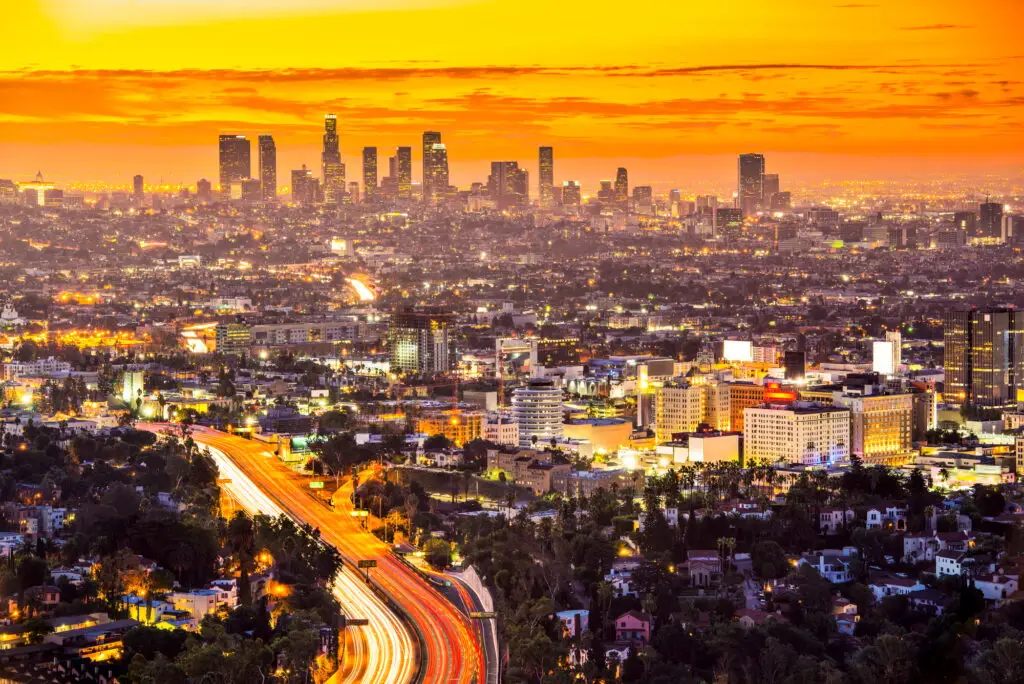
Los Angeles drivers lose the better part of two full work weeks to congestion every year, a figure that keeps this city at or near the top of every national traffic ranking. The busiest roads in Los Angeles are not just slow, though. They are where the region’s crashes concentrate, because stop-and-go density, aggressive merging, and distracted drivers stack risk on top of delay.
Here, we map LA’s worst traffic hotspots, the hours to avoid them, and the crash patterns on each corridor. We also cover two things every LA commuter and visitor should know before they need them: how fault works in a stop-and-go collision, and what to do if a crash happens in the middle of moving traffic.
Key Takeaways:
- The 405, the 10, the 101, the 60, and Sepulveda Boulevard rank among the most congested and crash-prone corridors in Los Angeles, each with distinct peak hours and risk patterns.
- Weekday congestion generally runs from about 6:30 a.m. to 10 a.m. and 3:30 p.m. to 7:30 p.m., with Friday afternoons starting earlier and lasting longer.
- Stop-and-go traffic produces predictable crash types, led by rear-end collisions, sideswipes during lane changes, and merge conflicts at interchanges.
- California law presumes nothing automatically in rear-end crashes, but Vehicle Code Section 21703 on following distance usually places fault on the trailing driver.
- Crashes in heavy traffic still require the same reporting, documentation, and medical follow-up as any other collision, including a DMV report when injuries or significant damage occur.
Table of Contents
ToggleThe Busiest Roads in Los Angeles Right Now
Five corridors carry an outsized share of the region’s congestion, and each one clogs for its own reasons. Live conditions on all of them are viewable through Caltrans traffic data, but the patterns below hold year after year.
I-405, the San Diego Freeway
The 405 through the Sepulveda Pass, between the 101 in the Valley and the 10 in West LA, is one of the most congested stretches of highway in the country. Peak hours run roughly 7 a.m. to 10 a.m. and 3:30 p.m. to 7:30 p.m., and the pass can crawl on weekends, too. The grade changes, and constant lane-jockeying make this corridor a rear-end and sideswipe factory.
I-10, the Santa Monica Freeway
The 10 moves the east-west commute between the coast, Downtown, and the Inland Empire, and it rarely rests between 6:30 a.m. and 9:30 a.m. or 4 p.m. and 7:30 p.m. Its defining hazard is ramp density, with closely spaced on-ramps and off-ramps producing continuous merge conflict through Mid-City. Sudden braking waves travel this freeway like weather.
US-101, the Hollywood Freeway
The 101 threads Downtown, Hollywood, and the Valley, and its interchanges with the 110 and the 405 are two of the region’s most reliable choke points. Congestion starts as early as 6 a.m. and the evening push stretches past 7 p.m. Tourist traffic adds an unusual ingredient, since drivers hunting for Hollywood landmarks brake and drift in ways commuters do not expect.
CA-60, the Pomona Freeway
The 60 is a working freeway, hauling a heavy share of the goods movement between Downtown and the Inland Empire. Commuters share every mile with commercial trucks, which means blind-spot collisions, long stopping distances, and serious crash forces when things go wrong, particularly near the 605 interchange. Early morning and late evening bring fatigued long-haul traffic into the mix.
Sepulveda Boulevard
The freeway alternative has become a hotspot in its own right, especially around LAX and through West LA, where navigation apps pour freeway refugees onto a street built for lighter loads. Signals, crosswalks, driveways, and heavy pedestrian activity make Sepulveda’s crash profile different from any freeway’s. The same holds for other app-favored surface routes across the city.
Every corridor on this list rewards timing more than route creativity. That timing map is next.
When Are the Worst Times to Drive in LA?
The short answer is weekday mornings from about 6:30 a.m. to 10 a.m. and afternoons from 3:30 p.m. to 7:30 p.m., with the evening peak consistently worse than the morning. The longer answer includes the exceptions locals plan around.
Fridays break the pattern early, with weekend-bound traffic building from 2 p.m. and holding past 8 p.m. on the routes out of the basin. Sundays produce their own late-afternoon surge as weekend travelers return. Holiday weekends compress all of it into the worst traffic times in Los Angeles, with the Thursday and Friday before absorbing much of the overflow.
Events move the map around. Dodger games flood the 110 and Sunset corridors, SoFi and Crypto.com events swamp Inglewood and Downtown, and award season closes streets in Hollywood outright. Checking event calendars before crossing those zones saves more time than any shortcut.
The Crash Patterns Each Corridor Produces
Congestion does not just slow down crashes; it selects which kinds happen. The region’s traffic hotspots generate a recognizable set:
- Rear-end collisions dominate stop-and-go corridors like the 405 and the 10, where braking waves catch drivers looking at anything but the car ahead.
- Sideswipes cluster where impatience meets density, as drivers force lane changes into gaps that close.
- Merge and ramp crashes concentrate at interchange choke points, with the 101/110 and 10/405 junctions among the region’s busiest for collisions.
- Truck-involved crashes track the freight corridors, especially the 60 and the 710, where a passenger car’s mistakes carry heavier consequences.
- Pedestrian and cyclist collisions follow the surface-street spillover, as freeway traffic diverts onto boulevards where people actually live and walk.
Distraction threads through all of it, since crawling traffic tempts drivers to reach for their phones, a behavior federal safety officials tie to thousands of deaths a year. The California Office of Traffic Safety publishes rankings showing how Los Angeles crash numbers compare across the state, and the hotspots above account for a heavy share.
Who Is at Fault in a Stop-and-Go Rear-End Collision?
Usually, the trailing driver, because California law requires every driver to leave enough room to stop. Vehicle Code Section 21703 prohibits following more closely than is reasonable for the speed and conditions, and the basic speed law requires speeds safe for traffic as it actually exists, including traffic that keeps stopping. A driver who plows into stopped cars was, almost by definition, going too fast for the conditions or following too closely.
Usually, it is not always, though. Chain-reaction crashes can shift fault to the driver who started the wave; a vehicle shoved into the car ahead may bear little or no responsibility, and abrupt, unnecessary braking can put a percentage of fault on the lead driver under California’s comparative negligence system. In multi-car freeway pileups, sorting the sequence of impacts is often the case.
That sequence lives in physical evidence: damage patterns on each vehicle, debris positions, and event data recorder downloads. Photographs taken before the vehicles move preserve more fault evidence than anything else a driver can do at the scene.
When the Road Itself Contributes to a Hotspot Crash
Some corridors stay dangerous no matter how carefully people drive them, and occasionally, the roadway is part of the reason. Faded lane striping through a merge zone, potholes that force sudden swerves, malfunctioning ramp meters, missing guardrails, and construction zones with confusing or absent signage have all contributed to crashes on LA’s busiest routes. When a public entity knew about a hazardous condition and left it in place, California law allows injured people to bring a claim against the agency responsible for the road.
These personal injury claims come with a catch worth knowing in advance. Government claims must be presented within six months, a quarter of the time allowed for an ordinary injury case, and they involve procedural requirements that trip up people who wait.
The practical takeaway is not that every pileup is the state’s fault, because most are not. It is that a crash in a location with a long collision history, visible disrepair, or active construction merits a second look at the roadway itself, and that look has to happen early.
What Should You Do After a Crash in Heavy Freeway Traffic?
Get out of the traffic lanes if the vehicles can move, because the second collision is the real danger. California law expects drivers in minor crashes to move to the shoulder or the nearest safe spot, and staying stopped in a live lane of the 405 invites a far worse impact than the first one. Hazards on, steer to the right shoulder or exit, and exchange information there.
If vehicles cannot move or anyone is hurt, stay belted inside the car with hazards on and call 911, rather than standing in traffic lanes. The CHP handles freeway crashes, and their report becomes the official record of a collision that dozens of drivers saw, but none will remember accurately. Photograph what you safely can, including the other car’s plate, before anyone relocates.
Two follow-ups apply, no matter how minor it felt. See a doctor promptly, since low-speed impacts still injure necks and backs, and file the DMV’s SR-1 report within 10 days if anyone was hurt or damage looks like it will top $1,000. Skipping either one weakens whatever claim follows.
Planning Around the Gridlock
The reliable moves are timing shifts and mode shifts, not secret routes. Leaving before 6:15 a.m. or after 10 a.m. beats any navigation trick on the corridors above, and the Metro’s E and B lines parallel two of the worst of them. For airport trips, the LAX transit connections and flyaway buses remove Sepulveda from the equation entirely.
When driving is unavoidable, the safety math is simple and unglamorous. Longer following distance absorbs the braking waves, phone in the mount rather than the hand keeps eyes on the wave forming ahead, and a calm exit from an aggressive driver’s orbit costs 15 seconds. Every one of those habits is cheaper than the crash it prevents.
None of it makes the 405 pleasant. It just gets you off it in one piece, which is the whole game.
FAQs: Los Angeles Traffic and Crash Questions
Life in this traffic raises practical questions that sit halfway between driving and law, and these come up the most.
Is it legal to drive on the shoulder to get around stopped traffic?
No, the shoulder is not a travel lane, and using it to bypass congestion is a violation that also creates real danger for stopped vehicles and emergency responders. Drivers who cause crashes while shoulder-running face a strong fault position against them. The exception is following official direction, such as CHP officers waving traffic around a closure.
Can a crash in slow traffic really cause serious injuries?
Yes, because injury tracks the change in motion, not the speedometer reading, and a 15 mph impact into a stopped car causes documented neck and back injuries. Insurers lean on low property damage to argue no one was hurt, and medical records beat that argument. Prompt evaluation after any impact protects both your health and the claim.
Is driving at 2 a.m. actually safer since the freeways are empty?
Emptier is not the same as safer, because late-night hours carry the highest rates of impaired and fatigued driving even as volumes drop. Speeds also climb on open freeways, which raises the severity of the crashes that do happen. The safest windows are typically mid-morning and early afternoon, when traffic moves but drivers are alert.
Do I have to report a fender-bender that happened in bumper-to-bumper traffic?
If anyone was injured or the damage appears to exceed $1,000, California requires an SR-1 report to the DMV within 10 days, regardless of how slow the traffic was. Exchanging information at the scene is required in every case. Skipping the report can jeopardize your license and complicate the insurance claim.
Are the cut-through streets that Waze recommends more dangerous than the freeway?
They carry different risks rather than fewer, since residential streets add pedestrians, children, cyclists, driveways, and uncontrolled intersections that freeways do not have. Crash severity tends to be lower, but crash opportunities multiply. Drivers using cut-throughs owe the neighborhood the speed and attention its design assumes.
What happens if someone crosses the double lines into the carpool lane and hits me?
Crossing the solid double lines into or out of an HOV lane is a violation, and it figures heavily in fault for the sideswipe crashes that maneuver causes. These collisions happen at a speed differential, since carpool traffic often moves while general lanes crawl, which makes injuries more likely. Dashcam footage is particularly valuable in these cases because the illegal crossing happens in seconds.
We Sit in This Traffic Too. We Also Handle What It Causes
 Every Los Angeles traffic accident attorney at our firm has crawled the same 405 merge and watched the same brake lights bloom on the 10, and that local knowledge shows up in how we build crash personal injury cases on these corridors. We’ve been in your shoes, and we know the law. M&Y Personal Injury Lawyers has recovered more than $800 million for injured Californians. Results may vary. Prior case outcomes do not guarantee similar results.
If LA traffic turned your commute into a claim, the conversation about it costs nothing. No fee applies unless we win.
Call 866-864-5477 any hour, or send the details through our contact page, and one of our Los Angeles traffic collision attorneys will follow up with you personally.