Free Consultation, Talk to a Real Lawyer Now.

Los Angeles Motorcycle Accident Lawyer/Lane Splitting

California is the only state in the country where lane splitting is fully legal, and somehow, the riders doing it legally still get blamed first when a car hits them. At M&Y Personal Injury Lawyers, our attorneys represent riders injured while lane splitting across Los Angeles, from the parking lot that is the 405 at rush hour to the surface streets of Downtown, and we spend a large part of that work correcting one persistent error: treating a lawful maneuver as if it were negligence. A lane-splitting accident lawyer’s first job in this city is making the law’s actual position clear to an adjuster who would prefer it stayed murky.

If a driver hit you while you were splitting lanes, call 866-864-5477 for a free consultation. There is no fee unless we win.

Table of Contents

Is Lane Splitting Legal in California?

Yes, unambiguously, and it has been codified into law. Vehicle Code Section 21658.1 defines lane splitting as driving a two-wheeled motorcycle between rows of stopped or moving vehicles in the same lane, and it authorizes the practice on both divided and undivided streets. The legislature passed that recognition through Assembly Bill 51, making California the first state to write lane splitting into law rather than merely tolerate it.

The distinction between legal and tolerated matters enormously after a crash. Before this codification, splitting lived in a gray zone that insurers exploited freely, and in the other 49 states, a splitting rider starts a claim with a traffic violation attached. A California rider starts with a lawful maneuver, full stop.

That legal status is the foundation of every case we build in this area. The rider was allowed to be exactly where they were, and the analysis moves to what the driver did about it.

What the CHP’s Lane-Splitting Safety Guidance Says

The statute directed the California Highway Patrol to develop educational guidelines, and those guidelines describe how experienced riders split safely rather than what the law requires. The CHP’s published guidance, reflected in the California Motorcycle Handbook, recommends keeping the speed differential with surrounding traffic modest, growing more cautious as overall speeds rise, and favoring the space between the far-left lanes, where drivers most expect motorcycles.

Read that paragraph carefully, because its legal weight is precise. The guidelines are safety education, not statutory requirements, and exceeding them is not a violation of any law. A rider splitting somewhat faster than the guidance suggests has not broken a rule, though insurers routinely blur that line.

The guidance still matters in litigation, in both directions. A rider who split within it has powerful evidence of reasonable conduct, and a rider who exceeded it faces an argument about degree, not an automatic finding of fault. We handle both situations, and the difference between them is far smaller than adjusters pretend something every experienced motorcycle accident lawyer knows well.

Who Is at Fault When a Car Hits a Lane-Splitting Rider?

Fault follows the movement, and in most splitting crashes, the vehicle that moved is the car. Vehicle Code Section 21658 requires a driver to stay within a single lane and to move from it only when the change can be made with reasonable safety, which includes checking for the motorcycles that California law explicitly allows between lanes. A driver who swings into the gap without signaling or looking has violated that duty, and the splitting rider’s presence was legal, foreseeable, and required checking for.

The same logic covers the impatient variations. Drivers who dart across a lane to grab a faster-moving one, drift while looking at their phones in stopped traffic, or lunge for an exit across the carpool lane buffer all move into space a rider lawfully occupies. In each pattern, the collision traces to the car’s movement, not the motorcycle’s position.

California’s comparative negligence system then allocates percentages, and that is where these cases are won or lost. Our work is proving the driver’s movement, the rider’s reasonableness, and the timing that connects them.

Blocking, Squeezing, and Door Checks: Illegal Responses to a Legal Maneuver

Some drivers resent lane splitting enough to act on it, and every version of that behavior is unlawful. Intentionally blocking a splitting rider with the car’s position, drifting toward the gap to intimidate, or squeezing the space closed is impeding a lawful movement, and the CHP’s guidance states plainly that motorists may not block or impede a lane-splitting motorcyclist. When intentional interference causes a crash, the conduct can support punitive damages, which exist to punish behavior rather than merely compensate for it.

The door check belongs in the same category. Vehicle Code Section 22517 prohibits opening a vehicle door into moving traffic unless it is reasonably safe, and a door swung into the path of a splitting rider in stopped traffic is a straightforward violation with catastrophic potential at even modest speeds.

Proving intent is the hard part, and it is why these cases lean on footage. A dashcam or helmet camera that captures a car drifting deliberately toward a rider converts a he-said dispute into a liability finding, and we canvass for that footage in every blocking case.

How Do Insurers Use Lane Splitting Against Riders?
By treating the maneuver itself as the negligence, which is exactly backward under California law. The adjuster’s playbook opens with the assertion that splitting is inherently dangerous, moves to the suggestion that the rider “came out of nowhere,” and lands on a fault percentage that quietly shifts a third or half of the blame onto a lawful act. Every point of that shift reduces the payout by the same percentage, so the framing is worth real money.

We answer the framing with the statute and the record. Lane splitting is legal, the driver’s duty to check before moving is unconditional, and “came out of nowhere” describes a failure to look, not a defense for it. Where the CHP guidance is relevant, we present it accurately as education rather than law, and we support the rider’s speed and positioning with reconstruction rather than the driver’s estimate.

Jury attitudes are the deeper current here, since some jurors arrive with the same bias adjusters that exploit. Preparing a splitting case for trial means confronting that bias directly with the law, and insurers who see that preparation tend to negotiate differently.

If an adjuster has already blamed your lane splitting for the crash, call 866-864-5477 before you respond.

The Crash Patterns Lane-Splitting Cases Involve

Lane-splitting crashes cluster into a handful of recognizable events, each with its own proof points. The patterns we see most across Los Angeles:

The unsignaled lane change, where a car jumps to the adjacent lane through the gap a rider occupies, is the dominant pattern on the 405, the 10, and the 101 at rush hour.

  • The mirror clip, where a drifting vehicle’s mirror strikes the rider or bars, often at low speed but with high fall risk.
  • The gap closes when two vehicles converge on the space between lanes simultaneously.
  • The sudden swerve, where a driver ducks out of a stopped lane to escape traffic, crossing the split lane without warning.
  • The door check, in stopped or crawling traffic, is addressed above.

Each pattern points to specific evidence, from mirror contact marks to lane-position debris. Identifying the pattern early tells us what to preserve first.

The First Minutes After a Splitting Crash Are Different

A splitting rider goes down in the most exposed spot on the road, the seam between two live lanes, so the first priority is getting out of it. If you can move, get to the shoulder or median rather than standing between lanes, and leave the bike where it fell if traffic allows, since its position is evidence. If you cannot move, stay as still as the situation permits and let stopped drivers shield the lane until help arrives.

The second difference is that these drivers leave, often without malice. A mirror clip or a squeeze registers as a bump to someone in a 4,000-pound car, and by the time the rider is off the ground, the vehicle is gone. Shout or note the plate if you possibly can, and ask stopped witnesses immediately whether anyone caught it, because dashcams in the surrounding traffic frequently did.

Then treat it like the serious event it is. Call 911, get the CHP or LAPD report started, photograph the bike’s position and the lane gap, and get medical care the same day. Splitting crashes at low speeds still break collarbones and wrists, and the record starts now.

Evidence That Proves a Splitting Rider Was Riding Reasonably
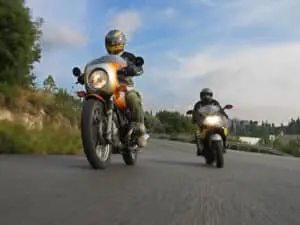
Los Angeles motorcycle accident lawyerThe case usually turns on two numbers, the rider’s speed and the differential with surrounding traffic, and both can be established without taking anyone’s word. Reconstruction from impact damage, throw distance, and the final positions yields the rider’s speed, while the surrounding traffic’s pace comes from the striking vehicle’s event data recorder and, on major corridors, from traffic-flow data the state collects continuously.

Footage does the rest of the work. Helmet cameras and dashcams capture the driver’s movement, the signal that never came, and the gap that existed until it did not, and nearby vehicles’ dashcams often saw what the parties could not. We send preservation requests within days, because loop-recording systems overwrite themselves on schedules measured in hours.

The rider’s own record rounds out the file. Endorsement history, training certificates, and gear condition quietly establish the rider as the careful operator that the evidence already shows, which matters when bias is the opposing counsel’s best asset.

Former Insurance Defense Lawyers, Now on the Rider’s Side

Several of our attorneys spent the first years of their careers defending insurance companies, which means the arguments aimed at splitting riders are arguments we once drafted ourselves. That history is the practical core of M&Y Personal Injury Lawyers: we know the fault-shifting playbook from the inside, and since 2013, we have used it in reverse to recover more than $800 million for injured Californians, including many who suffered serious motorcycle accident injuries.

Results may vary. Prior case outcomes do not guarantee similar results.

The rest of the firm is built to match. Over 100 employees, attorneys with a century of combined courtroom experience, and a practice where an attorney, not a case manager, runs your matter from the first call to the final payment. Riders find us mostly through other riders and through the 1,400+ five-star reviews that earlier clients left behind.

We answer 24/7, the consultation is free, and no fee exists unless we win. Call our firm before the adjuster’s version of your motorcycle crash hardens into the official one.

FAQs: Lane-Splitting Accidents in California

The legality of splitting generates follow-up questions that the statute does not answer directly, and these come up most often.

It is legal on any California road with multiple lanes moving in the same direction, surface streets included. The statute draws no freeway distinction, though the CHP guidance notes that surface streets add hazards like turning cars and driveways. Legality and wisdom are separate questions, and the law answers the first one the same everywhere.

No statute forbids a permit holder from splitting, but permit restrictions confine new riders to daytime surface streets, and splitting demands judgment that comes with experience. Training programs discourage it for new riders for safety reasons rather than legal ones. After a crash, a permit rider’s claim follows the same fault analysis as anyone else’s.

You have not broken a law, because the guidelines are educational rather than binding, and your claim survives. Expect the insurer to argue your speed differential as comparative fault, and expect the answer to come from reconstruction showing what actually caused the crash. A driver who never looks before moving is at fault, whether the differential was 10 mph or 20.

No, Section 21658.1 applies to two-wheeled motorcycles, and the lane-splitting authorization does not extend to bicycles, standup scooters, or most e-bikes. Different rules govern where those vehicles may ride. A crash involving them gets analyzed under those separate rules, not the splitting statute.

Footage that shows lawful riding is the single strongest asset a splitting case can have, and even imperfect footage usually helps by fixing the timeline. Once litigation is anticipated, the footage must be preserved rather than edited or deleted, since destroying it can damage the case more than anything it shows. Hand the original file to your attorney and let the evidence be what it is.

No, drivers on California roads are held to California law, including the legality of splitting and the duty to check before changing lanes. Unfamiliarity is not a defense, just as a Californian gets no pass for unfamiliar rules elsewhere. A visiting driver’s insurer will still argue bias against splitting, and the statute still answers it.

Lane Splitting Is Legal. Your Claim Should Be Treated That Way

Understanding Your Rights in Personal Injury Cases: A Comprehensive GuideYou rode within your rights under California law, and the claim that follows your crash should start from that fact rather than fight against it. M&Y Personal Injury Lawyers holds insurers to the statute, backs riders with evidence, and charges nothing unless we win. The consultation is free, whenever you are ready.

Call 866-864-5477 any hour, or tell us what happened through our contact page, and we will take it from there.

What Our Clients Say About Us – Client Review
Client Review

https://goo.gl/maps/hiKpNX8D5Gkh4KZ58

Read more of our reviews here.
Los Angeles Office Location

Visit our headquarters in LA to get the assistance you need, our law firm is located at 6300 Wilshire Blvd #960, Los Angeles, CA 90010.

Los Angeles Office Location

Visit our headquarters in LA to get the assistance you need, our law firm is located at 6300 Wilshire Blvd Suite 807, Los Angeles, CA 90048.

Highly Rated Local Auto Repair Shops Near You

  • J&S Onestop Auto Repair, Inc. – 4220 W Olympic Blvd, Los Angeles, CA 90019
  • Hans Beverly Auto – 4670 Beverly Blvd, Los Angeles, CA 90004

*Disclaimer – we do not endorse these companies or profit from having them listed on our website.

Car Accident Infographic

SEARCH OUR SITE

OUR OFFICES

Los Angeles - Main Office

6300 Wilshire Blvd. Suite 807
Los Angeles, CA 90048
Los Angeles Law Office Map

6300 Wilshire Blvd. Suite 807
Los Angeles, CA 90048
Los Angeles Law Office Map

350 S Figueroa St. Suite 276
Los Angeles, CA 90071
Downtown Los Angeles Law Office Map

Call: (877) 751-8953

402 W. Broadway #400
San Diego, CA 92101

Call: (619) 404-2797

2400 E Katella #800
Anaheim, CA 92806

Call: (714) 386-7623

8050 N. Palm Ave. #300
Fresno, CA 93711

Call: (559) 853-4863

6360 Van Nuys Blvd. #219
Van Nuys, CA 91401

Call: (213) 296-1243

11801 Pierce Street #200
Riverside, CA 92505

Call: (951) 234-5468

99 S Almaden Blvd #600
San Jose, CA 95113

Call: (408) 617-8928

111 West Ocean Blvd. #400
Long Beach, CA 90802

Call: (562) 354-8219

473 E. Carnegie Drive #200
San Bernardino, CA 92408

Call: (818) 650-3861