Key Takeaways:
- California Vehicle Code Section 26708 sets the legal limits for window tint on all passenger vehicles, trucks, vans, and SUVs in the state.
- Front side windows must allow at least 70% of visible light through when film and glass are combined, while aftermarket film on its own must allow 88% or more.
- Windshields may only carry a non-reflective tint strip on the top four inches, and red, amber, and blue tints are banned on every window.
- Backside windows and rear windows can be tinted to any darkness, but a tinted rear window requires side mirrors on both sides of the vehicle.
- Drivers with qualifying medical conditions can receive an exemption for a darker tint with documentation from a licensed physician, surgeon, dermatologist, or optometrist.
- Illegal window tint can become evidence in a California car accident claim, since the state’s comparative fault system weighs each driver’s conduct.
What Are the California Tint Laws?
California tint laws come from Vehicle Code Section 26708, which makes it illegal to drive with any material on your windows that blocks the driver’s clear view, then carves out specific exceptions. The statute allows tint only when it meets strict standards for light transmission, reflectivity, and color. These rules apply the same way to sedans, SUVs, pickup trucks, and vans, which makes California simpler than states that split the rules by vehicle type.
The law exists for a practical reason. Drivers need to see pedestrians, cyclists, and other cars clearly, and police officers and other drivers need some ability to see into a vehicle at intersections and crosswalks. Tint that is too dark cuts visibility at night and in low light, which raises the risk of a serious collision.
Anyone who drives in California should know these rules before paying for aftermarket film. A tint shop in another state, or even a careless installer here at home, may apply film that fails California standards, and the driver is the one who receives the ticket.
What Does VLT Mean Under California Window Tint Laws?
VLT stands for visible light transmission, and it measures the percentage of outside light that passes through a window. Under California window tint laws, a higher VLT number means a lighter window, and a lower number means a darker one. A window with 70% VLT lets 70% of visible light through, while a limo-style window with 5% VLT lets in almost none.
Every state sets its own VLT floor, which is why a truck that is street legal in Arizona can earn a ticket the moment it crosses into California. Manufacturers print the VLT rating on certified film, and officers can verify the number on the spot with a handheld meter.
VLT compounds when film is layered over glass. Nearly all factory auto glass already blocks a small share of light, so adding a legal film to slightly tinted factory glass can still push the combined reading below the legal limit.
California Tint Laws by Window
The legal darkness limit depends on which window you want to tint. Here is how the rules break down under Section 26708:
- Windshield: Tint is only allowed on the top four inches, and that strip must be non-reflective. The rest of the windshield must stay clear.
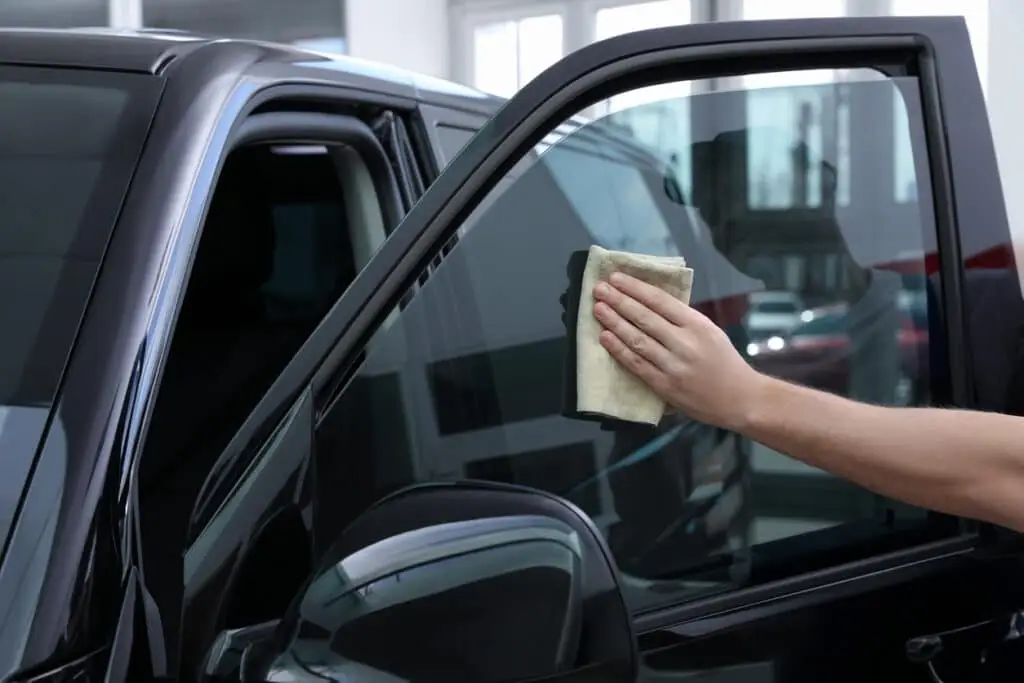
- Front side windows: The combination of film and glass must allow at least 70% of light through. Aftermarket film on its own must have a VLT of 88% or higher.
- Back side windows: Any level of darkness is allowed for windows behind the driver.
- Rear window: Any darkness is allowed, but if the rear window is tinted, the vehicle must have outside mirrors on both the left and right sides.
These limits apply to private passenger vehicles across the state, from a commuter sedan on the 405 in Los Angeles to a work truck in Fresno’s summer heat. Before you pay for installation, ask the shop to confirm in writing that the film meets California’s standards for each window.
Reflectivity and Color Rules for Window Tint in California
 Darkness is only part of the equation, because California also regulates how shiny and what color your tint can be. The law prohibits any window film that is more reflective than a standard, untreated window. Mirrored or metallic finishes that bounce sunlight at other drivers are not allowed on any window.
Color restrictions are just as firm. Red, amber, and blue tints are banned on every window of the vehicle, no matter how light the shade. Those colors are reserved for emergency vehicle lighting, and glass that mimics them can confuse other drivers on the road.
California also regulates the businesses that sell and install film. Vehicle Code Section 26708.5 prohibits installing any transparent material that changes the color or reduces the light transmittance of a window unless it meets state standards. Certified installers must give you documentation showing the film manufacturer’s name and address, and you should keep that certificate or sticker in the vehicle in case an officer asks for it.
Medical Exemptions Under California Tint Laws
Some drivers need darker glass for health reasons, and California tint laws account for that. Section 26708 allows an exemption for people with medical conditions that make them unusually sensitive to sunlight, such as lupus, xeroderma pigmentosum, or a heightened risk of skin cancer. State legislation expanded the exemption so that a licensed physician and surgeon, dermatologist, or optometrist can sign the required documentation.
The exemption comes with conditions. The letter must describe the medical need, the driver must keep the documentation in the vehicle, and the windshield and front side windows still cannot fall below certain visibility standards, especially for night driving. An exemption is not a blank check for limo tint on every window.
If you believe you qualify, talk with your doctor and get the paperwork before the film goes on. Having the letter in your glovebox can turn a roadside stop into a two-minute conversation instead of a citation.
What Happens if You Get Pulled Over for Illegal Tint in California?
A first offense for illegal tint is usually treated as a correctable violation, commonly called a fix-it ticket. Under California Vehicle Code Section 40610, an officer can issue a notice to correct instead of a standard fine when the violation does not involve fraud or a persistent safety hazard. The driver removes the illegal film, has an authorized official sign off on the correction, and pays a small dismissal fee to close out the ticket.
Repeat violations are treated differently. A driver who ignores a correction notice or gets cited again can face an infraction with a fine that runs close to $200 once fees are added, and the court can require proof of correction before dismissing anything. The California Courts self-help center explains how to handle a correctable violation and what happens if you miss the deadline.
Tint stops carry one more consequence that surprises people. An officer who lawfully stops a vehicle for a tint violation can address anything else in plain view, so a $25 fix-it ticket can grow into a much bigger problem. Keeping your windows within the legal limits is the simplest way to avoid the entire chain of events.
Can Illegal Window Tint Affect a Car Accident Claim in California?
Yes, illegal tint can influence a California car accident claim because it speaks to visibility and driver conduct. California follows a pure comparative negligence system, which means fault can be split between drivers by percentage, and each driver’s compensation is reduced by their share of the blame. If a driver with unlawfully darkened front windows fails to see a pedestrian or another car at dusk, that tint can become evidence that the driver contributed to the crash.
Insurance companies know this, and their adjusters look for any detail that shifts fault. If the other driver’s windows were illegally darkened, photographs of the vehicle, the tint certificate (or the lack of one), and repair records can all support your claim. If your own windows were tinted, expect the insurer to raise it, even when the tint had nothing to do with the collision.
This is where evidence gathered early makes a real difference. Photos taken at the scene, the California Highway Patrol or local police report, and witness statements can establish what each driver could actually see. The sooner that evidence is preserved, the harder it is for anyone to rewrite the story later.
How to Confirm Your Tint Is Legal Before the Film Goes On
The cheapest way to handle a tint problem is to prevent it at the shop counter. Before any installation, ask the shop to show you the manufacturer’s certification for the exact film they plan to use, since California only permits certified products. A reputable installer will hand over the certificate without hesitation and give you the sticker required by state law.
Ask for a meter reading, not a brochure number. The VLT printed on the box measures the film alone, while California tint laws judge the combined reading of film plus glass, so a shop should measure your actual windows before and after installation. If an installer will not put the combined number in writing, take your business elsewhere.
Heat protection does not require dark film. Modern ceramic films block most infrared heat and nearly all UV rays at 70% VLT or lighter, which keeps front windows fully legal while still cooling the cabin during a Valley summer. Drivers who want relief from the sun rarely need darkness to get it.
Buying a used car calls for the same caution. Film installed by a previous owner becomes your legal problem the day the title transfers, so have a shop meter the windows before you register the vehicle. Ten minutes with a tint meter costs far less than a citation and a removal bill.
Small Details Decide Real Cases. Tell Us About Yours
 Illegal tint is exactly the kind of detail an insurance adjuster will use against you, and exactly the kind our car accident attorneys use to prove what the other driver could not see.
M&Y Personal Injury Lawyers has recovered more than $800 million for injured Californians since 2013. Results may vary. Prior case outcomes do not guarantee similar results.
Every case starts the same way: a free conversation about what happened, with no fee unless we win.
Call 866-864-5477 whenever it works for you, day or night, or share the details through our contact page, and an attorney will review your situation personally.