Key Takeaways:
- Los Angeles operates several distinct camera systems, including a small number of county red light cameras, thousands of LADOT signal-monitoring cameras, Caltrans freeway cameras, and Metro bus-mounted cameras.
- Many government traffic cameras in Los Angeles provide live monitoring only and do not retain recordings, so private security cameras and dashcams often matter more in accident cases.
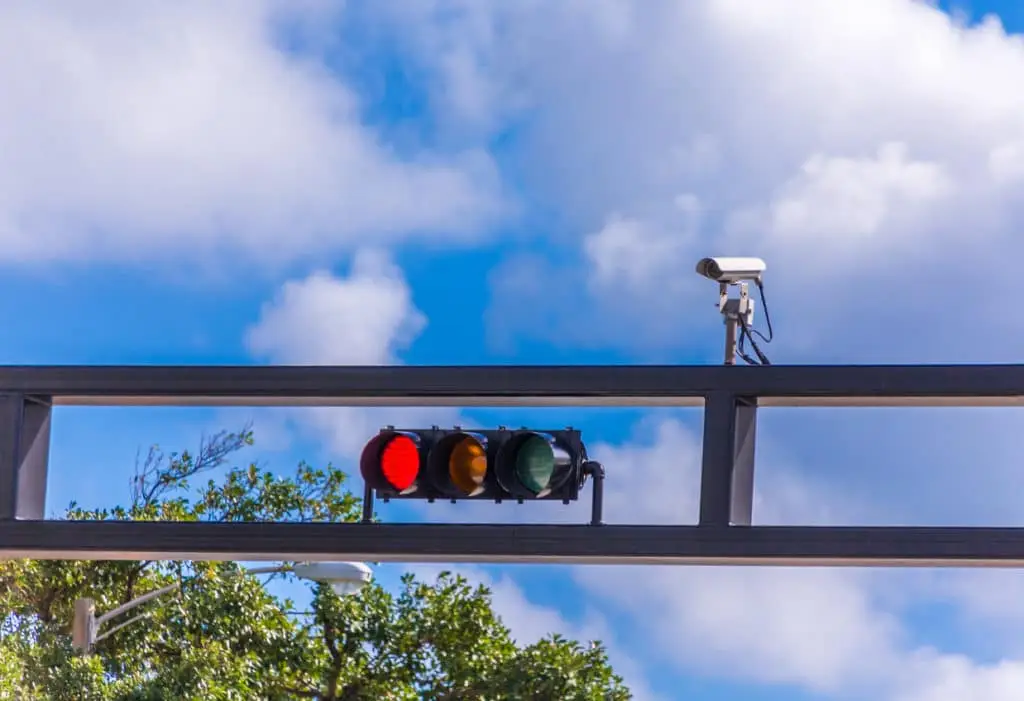
- Red light camera systems authorized under California Vehicle Code Section 21455.5 capture photographs and short video clips that can document a crash at an equipped intersection.
- Camera footage is generally admissible in California courts when properly authenticated, and it can establish light phase, speed, and lane position more reliably than witness memory.
- Retention windows are short, sometimes days, so preservation requests sent early often determine whether footage exists by the time a claim is filed.
What Kinds of Traffic Cameras Operate in Los Angeles?
 Five different camera systems watch Los Angeles streets, and they serve very different purposes. Knowing which type covered your intersection is the first step in figuring out whether footage of your crash exists anywhere.
- Red light photo enforcement cameras: Los Angeles County Public Works operates automated red light cameras at a small number of unincorporated county intersections, after the City of Los Angeles shut down its own program in 2011.
- LADOT signal cameras: The city’s ATSAC system monitors thousands of signalized intersections with closed-circuit cameras that engineers use to manage traffic flow in real time.
- Caltrans freeway cameras: The state streams live freeway video, viewable by the public through Caltrans QuickMap, covering the 101, the 405, the 10, and other routes.
- Metro bus cameras: Transit buses carry forward-facing cameras that record bus lane violations and capture whatever happens in front of the bus.
- Private cameras: Businesses, apartment buildings, parking lots, doorbell systems, and dashcams blanket the city more densely than any government program.
The category determines everything about whether the video survives. That question gets its own section, because the answer defeats most people’s expectations.
Do Los Angeles Traffic Cameras Record and Keep Footage?
Mostly no, and this is the hard truth at the center of camera evidence. LADOT’s intersection cameras and Caltrans freeway feeds are monitoring tools, streamed live to traffic management centers and generally not recorded or archived. A camera on a pole above your crash does not mean a recording of your crash exists.
The recording exceptions are specific. County red light cameras capture still photos and a short video clip, but only when a vehicle triggers the system by entering the intersection against the light. Metro bus cameras record continuously while the bus operates, and private security systems record around the clock, typically overwriting themselves on a loop.
Retention is the second trap. Systems that do record often keep footage for a short window, from a few days for some transit and government systems to roughly 30 days for many businesses, before it is overwritten automatically. The clock starts at the moment of the crash, not the moment you decide to pursue a claim.
Red Light Cameras as Evidence in a Car Accident Case
When a crash happens at an equipped intersection, red light camera systems produce some of the most objective evidence available. Programs operating under Vehicle Code Section 21455.5 photograph the vehicle before the limit line, in the intersection, and capture the license plate, along with a timestamped video clip of the sequence. For a disputed left-turn or T-bone collision, that sequence can show exactly which driver had the light.
California courts accept this footage when it is properly authenticated, meaning someone establishes what the camera recorded, when, and that the system was functioning. Authentication is routine for these programs because the operators maintain calibration and maintenance records as a matter of course. The footage itself is neutral, which is precisely its value: it has no memory gaps, no loyalty, and no reason to shade the story.
One clarification worth making, since the original version of this article focused on citations, is whether anyone received a ticket is a separate question from whether the footage helps a personal injury claim. Evidence of what happened matters in a civil case even when no citation was ever issued.
How Lawyers Obtain Camera Footage After a Crash
Footage rarely arrives just by asking nicely, and each camera type has its own door. For government systems, a request under the California Public Records Act can reach recordings that agencies retain, while red light camera records tie into confidentiality rules that usually require a subpoena once litigation begins. For Metro bus video, a preservation request sent to the agency quickly is the difference between evidence and an overwritten hard drive.
Private footage moves on relationships and speed. Our office sends preservation letters to businesses and property owners near a crash scene within days of being retained, asking them in writing to hold specific date and time ranges. Most owners cooperate once asked, and a letter creates accountability if footage disappears after notice, which matters most for crashes that happen during the worst traffic times in Los Angeles, when multiple nearby cameras may have captured the same incident.
Dashcams and doorbell cameras get canvassed the old-fashioned way. Someone walks the block, knocks on doors, and checks which houses and storefronts face the intersection. In a city with this much private surveillance, that canvass succeeds more often than people expect.
What a Preservation Letter Actually Says
A preservation letter, sometimes called a spoliation letter, is a short written demand that a footage holder retain specific recordings because litigation is reasonably anticipated. It identifies the camera location, the date, and a time window around the crash, and asks the recipient to suspend any automatic deletion for that range. Nothing about it requires the recipient to hand the footage over yet; it only obligates them to stop the overwrite cycle.
The letter’s power comes from what happens if it is ignored. California courts can penalize a party that destroys evidence after receiving notice, and juries are permitted to draw negative conclusions from that destruction. Businesses understand this, which is why a one-page letter usually accomplishes what a phone call cannot.
What Can Camera Footage Prove in an Injury Claim?
Video answers the questions that fault disputes turn on. In a comparative negligence state like California, where each driver’s share of blame reduces their recovery by that percentage, footage can move a case from a stalemate of competing stories to a settled question. A few seconds of video can establish:
- Which driver had the green, yellow, or red light, and for how long
- Approximate speed, based on the distance covered between frames
- Lane position, turn signals, and whether a driver drifted or swerved
- Whether a pedestrian was inside a crosswalk when struck
- Driver behavior before impact, such as looking down at a phone
- Road conditions, lighting, and obstructions at the exact moment of the crash
Insurance adjusters respond to footage differently than they respond to statements, because video removes the room for argument. Claims supported by clear video tend to resolve faster and closer to their real value.
Speed Safety Cameras Are Coming to Los Angeles Streets
A new generation of recording cameras is arriving under Assembly Bill 645, which authorized a speed safety camera pilot program in Los Angeles and five other California cities. The systems photograph vehicles exceeding the speed limit by 11 mph or more in school zones, high-injury corridors, and areas with a history of street racing. Los Angeles has been rolling out its pilot locations, marking the city’s first automated camera expansion in more than a decade.
For injury cases, the pilot matters beyond its enforcement purpose. Each installation creates a new fixed camera at exactly the kinds of locations where serious pedestrian and cyclist crashes concentrate. As these systems come online, the map of intersections where crash footage might exist grows with them.
The pilot comes with privacy guardrails that shape what evidence the systems produce. AB 645 requires cameras to photograph the rear of the vehicle rather than faces, limits how long the program retains images, and restricts what the data can be used for.
Those limits mean speed camera records will be narrower than red light camera evidence, useful for establishing that a specific vehicle was speeding at a specific moment, but not a substitute for full crash video. Attorneys requesting these records will need to move within the retention window, which is measured in days for images not tied to a violation.
The program also signals where the city believes the danger is. A crash inside a designated high-injury corridor carries context that a car accident attorney can use when reconstructing what happened and why.
When There Is No Camera: Other Evidence That Fills the Gap
Plenty of strong cases are built without a single frame of video. Modern vehicles carry an event data recorder, the so-called black box, which the National Highway Traffic Safety Administration describes as capturing speed, braking, throttle, and seatbelt status in the seconds before a collision. That data often proves the same facts as footage would, sometimes more precisely.
Physical evidence does quite work too. Skid mark length, crush damage depth, debris fields, and final resting positions let reconstruction specialists calculate speeds and angles. Cell phone records can establish whether a driver was texting at the moment of impact.
Witnesses round out the picture, and the earlier their statements are captured, the more they are worth. Memory fades within days, which is one more reason the first week after a crash matters more than any other.